
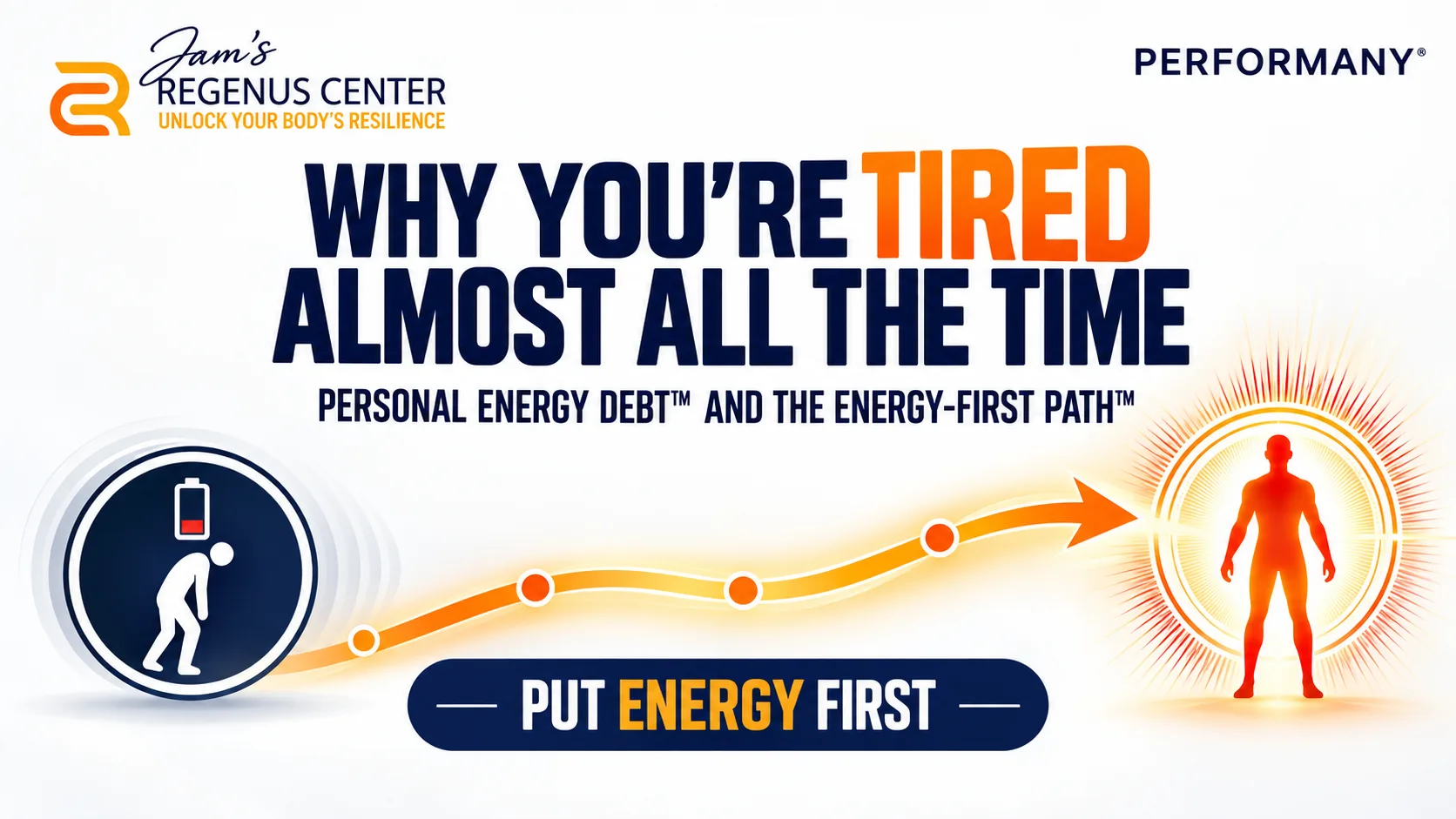
Why You’re Tired Almost All the Time: Personal Energy Debt and the Energy-First Path™
You may be doing everything you are supposed to do.
You work. You take care of people. You exercise when you can. You try to eat well. You push yourself to remain productive, responsible, and capable.
Yet you still feel tired almost all the time; you’re inflamed, and probably have aches and pains that distract and hold you back from living better.
You sleep, but do not always feel restored. You take a day off, but the relief does not last. You use caffeine, motivation, discipline, or sheer willpower to keep moving.
Eventually, you begin wondering:
Why can’t I restore my energy the way I used to?
The problem may not be that you are lazy, unmotivated, or simply “getting older.”
The problem may be that your energy expenditure has been outpacing your ability to recover for so long that you are now carrying what we call Personal Energy Debt™.
We Were Taught to Put Energy Last
Most of us were never taught how to put it first, let alone manage energy.
We were taught how to manage time, money, schedules, responsibilities, projects, and other people’s expectations. We were taught to work harder, become more disciplined, and push through resistance.
But we were rarely taught to ask:
Do I have the physical, mental, and emotional capacity to sustain the life I am building?
Instead, we put energy last.
We schedule everything else first and expect whatever energy remains to carry us through it all.
That may work for a while—especially if you are highly capable. But when the demands placed upon you continually exceed your ability to recover, the difference does not simply disappear.
It accumulates.
That accumulating deficit is Personal Energy Debt™.
What Is Personal Energy Debt™?
Personal Energy Debt™ is the growing gap between the energy your life requires and your ability to restore that energy.
It is not a medical diagnosis. It is a practical way of understanding a pattern many people experience:
- Demand remains high.
- Recovery becomes inconsistent.
- Sleep alone no longer feels sufficient.
- Stress becomes continuous rather than temporary.
- Pain and inflammation consume additional capacity.
- Healthy behaviors become harder to maintain.
- You continue functioning, but increasingly below your true capacity.
Science describes this process in several related ways.
One is allostatic load, which refers to the cumulative physiological burden created when the body must repeatedly adapt to stress. Your stress-response systems are designed to help you handle a challenge and then return toward balance. But when stress is frequent, prolonged, or combined with inadequate recovery, those systems can remain under pressure.
Researchers measure allostatic load using combinations of cardiovascular, metabolic, immune, hormonal, and other biological markers. Higher allostatic load has been associated with poorer long-term health outcomes, although researchers are still working toward a fully standardized definition and measurement method. Research on defining allostatic load and a systematic review of its association with mortality support the larger idea that accumulated physiological strain matters.
Personal Energy Debt™ translates that complex science into a question you can use in everyday life:
Is my recovery keeping pace with the demands being placed upon me?
Why Sleep May Not Be Solving the Entire Problem
Sleep is essential. There is no substitute for it.
But sleep and recovery are not exactly the same thing.
Sleep is one of the body’s most important recovery processes. Recovery is the larger job of repairing, regulating, replenishing, and adapting after physical, mental, emotional, and environmental demands.
If your overall recovery demand is greater than what your sleep and lifestyle can support, you may wake up having slept—but still not feel restored.
Inadequate or disrupted sleep can also compound the problem. Research has connected sleep disturbance with inflammatory activity, and experimental sleep deprivation has been shown to increase pain sensitivity in healthy people. A systematic review of sleep and inflammation found that sleep disturbance and long sleep duration were associated with higher levels of certain inflammatory markers. A separate systematic review and meta-analysis found that different forms of sleep deprivation could lower pain thresholds, increase spontaneous pain, and worsen pain sensitization.
This helps explain why energy, pain, and recovery can become connected.
When you are tired, pain may feel more intense. When you are in pain, sleep and movement may become more difficult. When movement decreases and stress increases, your capacity may decline further.
It can become a self-reinforcing cycle.
The Opposite of Living Free, Fully, and Well
The purpose of restoring energy is not simply to feel more awake.
Energy affects your ability to think clearly, regulate your emotions, move your body, make decisions, recover from stress, and participate fully in your own life.
When more energy is available beyond the demands of running your body, you have more capacity to live free, fully, and well.
When energy remains depleted, life can gradually become the opposite:
Constrained, diminished, and unwell.
You may still be accomplishing things. You may still look successful from the outside. But more of your life becomes organized around getting through the day rather than living it.
That is why we created the Energy-First Path™.
What Is the Energy-First Path™?
The Energy-First Path™ is a structured approach to:
- Recognizing Personal Energy Debt™
- Restoring energy
- Establishing a repeatable recovery rhythm
- Expanding personal capacity
- Building a Performance Lifestyle® that can be sustained
It does not reduce the answer to one supplement, one technology, one workout, one diet, or one treatment.
Those may all play a role. But the larger issue is whether the different parts of your lifestyle work together to restore and sustain your capacity—or whether they continually drain it.
The Path begins with energy because energy is what allows you to do everything else.
- You need energy to exercise.
- You need energy to prepare healthy food.
- You need energy to think clearly.
- You need energy to manage stress.
- You need energy to remain patient with the people you love.
- You need energy to make changes and sustain them long enough for those changes to matter.
- Knowing what to do isn’t enough when you don’t have the energy to do it.
Level 0: Recognize the Energy Debt
The first step is honest recognition.
You may be capable, but depleted.
You may still be working, performing, and fulfilling your responsibilities, but doing so below your actual capacity because recovery has fallen behind demand.
This is Level 0 on the Energy-First Path™.
At this stage, the first goal is not to push harder. It is to understand what’s draining your energy and why your current recovery practices aren’t keeping pace.
Persistent fatigue can also have medical causes, including sleep disorders, anemia, thyroid conditions, infections, medication effects, depression, and other health problems. Discuss new, severe, unexplained, or persistent fatigue with a qualified healthcare professional.
But when urgent or underlying medical issues have been appropriately evaluated, you can begin looking at the broader relationship between demand, recovery, and lifestyle.
Level 1: Begin With a BioVitality Protocol™
Information alone may not be enough when you are significantly depleted.
You can know that nutrition, conditioning, sleep, grounding, recovery, and mindset matter—and still lack the energy required to practice them consistently.
That is why the first implementation of the Energy-First Path™ is the BioVitality Protocol™ at Regenus Center.
The protocol is a strategically sequenced recovery experience designed to help restore your system, accelerate energy recovery, and support healing and adaptation.
Depending on the individual, it may incorporate:
- Advanced red light therapy photobiomodulation
- PEMF and resonant-frequency technologies
- Oxygen-enhanced exercise
- Compression and lymphatic support
- Infrared sauna
- Cold immersion or contrast therapy
The purpose is not to overwhelm you with a collection of wellness services.
The purpose is to use appropriate recovery modalities in a structured way so that you can begin rebuilding capacity.
Why We Begin With Advanced Photobiomodulation
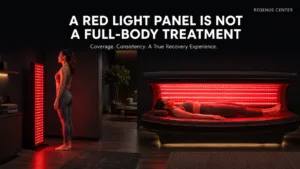
At a minimum, the BioVitality Protocol™ begins with advanced red and near-infrared light therapy, also known as photobiomodulation, or PBM.
Photobiomodulation delivers particular wavelengths of light to the body. Research suggests that this light can interact with cellular signaling and mitochondrial processes involved in energy metabolism, blood flow, oxidative balance, and inflammation.
Mitochondria are often described as the powerhouses of the cell because they help convert energy from food into ATP—the immediately usable energy that supports cellular work.
The science is more complicated than simply “light creates ATP.” Researchers are still studying the precise mechanisms, optimal wavelengths, dose, timing, and treatment parameters. Current models involve mitochondrial signaling, redox balance, nitric oxide, ion channels, and other biological pathways. A review of mitochondrial signaling in photobiomodulation explains why PBM is best understood as a biological signaling intervention rather than merely a source of heat or illumination.
Evidence also varies considerably by condition and application.
For example, a 2026 systematic review of randomized trials found that PBM showed pain-relieving potential in several chronic-pain populations, with relatively few reported adverse events. However, protocols differed substantially among studies, making broad conclusions and universal dosing recommendations difficult. Review of PBM for chronic pain.
Research involving whole-body photobiomodulation is newer than research involving localized PBM, and scientists are still determining the most effective wavelengths, intensity, timing, and dosing for different goals.
That is why we don’t present photobiomodulation as a cure-all or the complete answer to low energy. We use it as a foundational part of a broader BioVitality Protocol™—one that combines advanced recovery technology with the rhythms, behaviors, and lifestyle practices required to restore and sustain energy over time.
Our approach is informed by emerging science and by what we have observed across more than 58,000 sessions delivered in a real-world recovery environment. That experience does not replace controlled research, but it has shown us the meaningful role advanced photobiomodulation can play in helping people establish a consistent recovery practice.
A larger body of research involves localized PBM, while research on whole-body PBM remains early. Our front-line experience delivering advanced PBM across tens of thousands of sessions has helped shape the BioVitality Protocol™, but practical experience should complement—not replace—controlled scientific evidence.
We believe in remaining close to both: the emerging science and what we observe while serving real people.
The Protocol Is the Beginning—Not the Whole Answer
A BioVitality Protocol™ may help you begin recovering, but no recovery technology can compensate indefinitely for a lifestyle that continually drives you back into debt.
The reason you are tired almost all the time may involve several interacting factors:
- Insufficient or disrupted sleep
- Continuous psychological stress
- Pain or persistent inflammation
- Poor metabolic health
- Inadequate nutrition
- Too little movement—or more exercise than you can recover from
- Emotional strain
- Environmental demands
- Lack of meaningful renewal
- A schedule built around output without recovery
This is why the Energy-First Path™ extends beyond biology and beyond Regenus Center.
At Regenus Center, we do not want to show you only what to use. We want to help you understand the larger system—what drains your energy, what restores it, and how to build a lifestyle that can sustain it.
Level 2: Establish a BioVitality Rhythm™
One good recovery experience can help, but your life will continue making withdrawals.
You therefore need a repeatable pattern of renewal.
We call this your BioVitality Rhythm™: a proactive rhythm of energy restoration and recovery that occurs before you are completely depleted.
The BioVitality Rhythm™ is the most basic unit of a Performance Lifestyle®.
It changes the question from:
“What should I do once I am exhausted?”
to:
“How will I restore my energy consistently enough to prevent exhaustion from becoming my normal state?”
For one person, this may begin with weekly recovery sessions. Another may need a more concentrated protocol followed by a maintenance rhythm. The right frequency depends on the individual, their condition, their goals, their response, and the demands of their life.
The principle is what matters:
Recovery must become rhythmic—not merely reactive.
Level 3: Extend Recovery Beyond the Center
A center can help you begin, guide you, and provide access to multiple advanced modalities.
But you should not remain completely dependent on traveling to a recovery center for everything you need indefinitely.
For the everyday use of advanced whole-body photobiomodulation, access matters. Consistency becomes far more realistic when the technology is available where you live or work.
That is why we created BioVitality Pro®.
BioVitality Pro® brings the foundational light component of the BioVitality Protocol™ into the home or office. It becomes part of what we call your Personal Energy Infrastructure™—the technologies, practices, environments, and rhythms that make recovery more accessible in everyday life.
This does not necessarily replace Regenus Center.
The center can remain your resource for complementary modalities, advanced protocols, assessment, guidance, and periodic renewal. But the most frequently used element of your recovery rhythm no longer depends entirely on appointments or travel.
Learn more about BioVitality Pro®
Level 4: Build a Lifestyle That Performs
Technology can help create the conditions for recovery, but technology alone is not a Performance Lifestyle®.
A Performance Lifestyle® includes how you:
- Ground yourself
- Regenerate and recover
- Nourish your body
- Move and condition yourself
- Resolve what repeatedly drains you
- Evolve how you live
- Pursue meaningful achievement
The objective is not peak performance at every moment.
That is neither realistic nor sustainable.
The objective is to become a healthier, higher-capacity human who can meet meaningful demands, recover effectively, and continue living with energy, purpose, and resilience.
This is where the entire Path has been leading.
Not simply toward feeling less tired.
Toward having the capacity to live more fully.
Come to Regenus Center With a Different Mindset
When you begin at Regenus Center, do not think of it as merely visiting a place for red light therapy or trying a collection of recovery services.
Come with a larger mindset:
Grounding, nutrition, conditioning, sleep, recovery, and mindset are all essential. But first, I need enough energy and capacity to practice them consistently amid the demands of my life.
Begin with a BioVitality Protocol™.
Establish a BioVitality Rhythm™.
Learn what is creating your Personal Energy Debt™.
Then begin building the lifestyle and personal infrastructure that allow you to restore, protect, and direct your energy more intelligently.
Put Energy First
You were probably taught to build your life first and hope you would have enough energy to sustain it.
The Energy-First Path™ reverses that order.
Understand the debt.
Restore your energy.
Establish your rhythm.
Expand your capacity.
Build a lifestyle that performs.
Because energy is not merely something you need to get through your day.
It is the capacity through which you experience your health, your work, your relationships, your purpose, and your life.
Build a lifestyle that performs—beginning with putting energy first.
Experience the BioVitality Protocol™ at Regenus Center
This article is provided for educational purposes and is not medical advice. Regenus Center services and BioVitality Pro® are not intended to diagnose, treat, cure, or prevent disease. Anyone experiencing persistent, severe, or unexplained fatigue, pain, or other symptoms should seek evaluation from a qualified healthcare professional.