
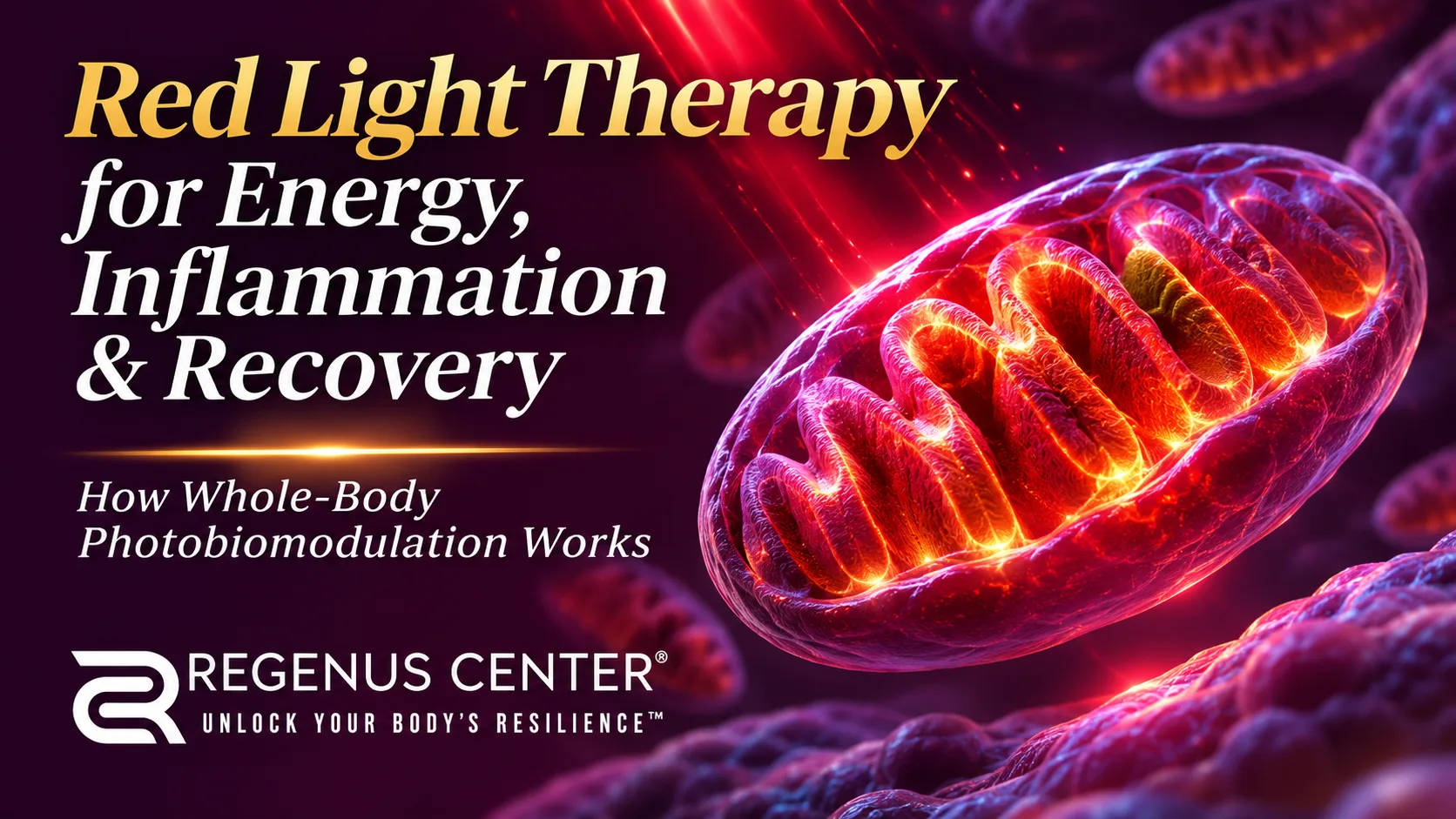
Red Light Therapy for Energy, Inflammation and Recovery: How Whole-Body Photobiomodulation Works
Discover why advanced red and near-infrared light therapy is becoming an important tool for cellular energy, recovery, resilience, and healthy, high-capacity living.
By John Allen Mollenhauer (JAM), Founder of Regenus Center
Red light therapy for energy, inflammation, and recovery is an increasingly popular application of whole-body photobiomodulation, a technology that influences cellular activity and supports the body’s natural recovery processes.
What if your body could recover better than it does today?
What would it mean to wake up feeling more energized, think more clearly throughout your day, experience less of the nagging discomfort you’ve almost learned to live with, and recover more effectively from everything you’re up to in life?
For many people, particularly those navigating the demands of midlife, the challenge is no longer finding the motivation to do more.
It’s having the energy and physical capacity to sustain all that they’re doing.
We work hard. We exercise. We raise families, build businesses, manage careers, and pursue ambitious goals. Yet we often spend remarkably little time actively helping our bodies recover from the cumulative demands of our lives.
Over time, that can create what I call Personal Energy Debt™ — a growing gap between the energy you expend and your ability to recuperate.
This is one of the reasons we established Regenus Center in East Hanover, New Jersey, and why advanced whole-body photobiomodulation, popularly known as red light therapy, is foundational to our approach.
What Is Red Light Therapy, and How Does It Work?
Red light therapy, scientifically known as photobiomodulation (PBM), uses specific wavelengths of red and near-infrared light to influence biological activity within cells and tissues.
Unlike ultraviolet light, which can damage the skin, photobiomodulation uses non-ionizing light delivered at controlled doses.
Its effects extend beyond the surface of the skin. Depending on the wavelength, dose, and tissue being exposed, light can influence cellular signaling, mitochondrial activity, and biological processes associated with repair and recovery.
These are some of the reasons photobiomodulation is being studied and applied in fields ranging from sports medicine and rehabilitation to dermatology and regenerative health.
The science becomes particularly interesting when we understand the relationship between light and cellular energy.
How Red Light Therapy Supports Cellular Energy Production
Inside most of your cells are structures called mitochondria.
Often referred to as the powerhouses of your cells, mitochondria produce much of the adenosine triphosphate, or ATP, that your body uses to power biological functions.
ATP is essential for muscle contraction, cellular repair, nervous system activity, and countless other processes that keep you functioning.
One of the leading explanations for how red and near-infrared light therapy works involves an enzyme in the mitochondria called cytochrome c oxidase.
Research suggests that photobiomodulation can influence mitochondrial respiration, ATP production, nitric oxide signaling, and other processes involved in cellular function.
In other words, light can do considerably more than illuminate or warm the body. Under appropriate conditions, it can influence how cells function.
Read the scientific research on photobiomodulation and mitochondrial signaling.
This is fundamentally different from relying on caffeine or other stimulants to push through another demanding day.
Rather than simply trying to feel more stimulated, we want to support the biological systems responsible for producing energy and recovering from stress.
Can Red Light Therapy Help Reduce Inflammation?
Inflammation is not inherently bad.
It is an essential part of your body’s defense, repair, and adaptation processes.
However, persistent or excessive inflammation can contribute to pain, stiffness, and impaired physical function, making it more difficult to stay active and recover effectively.
Research into photobiomodulation has identified several mechanisms through which red and near-infrared light can influence inflammatory activity, including:
- Modulation of inflammatory signaling pathways
- Changes in oxidative stress responses
- Regulation of immune cell activity
- Support for biological processes involved in tissue repair
Scientific investigations have documented anti-inflammatory effects in laboratory models and certain clinical applications.
Read the research on the anti-inflammatory mechanisms of photobiomodulation.
At Regenus Center, we view inflammation management and energy recovery as closely connected aspects of supporting the body’s resilience.
Can Red Light Therapy Help With Fatigue and Burnout?
One of the most common concerns we encounter at Regenus Center is people who are tired almost all the time.
These are often highly motivated, accomplished individuals who have spent years operating under considerable physical, mental, and emotional demands.
They don’t necessarily need another motivational speech.
They need to give their bodies a greater opportunity to recuperate.
Photobiomodulation is an interesting recovery technology because of its interaction with cellular metabolism and biological signaling.
However, fatigue is complex. It can result from insufficient sleep, nutritional deficiencies, medical conditions, excessive stress, or a combination of factors. Persistent or unexplained fatigue should be medically evaluated.
We incorporate whole-body light therapy into a broader energy-first approach that recognizes the importance of sleep, nutrition, physical activity, and proactive recovery.
The objective isn’t simply to help you get through another day.
It’s to help you develop the capacity to sustain the life you want to live.
Red Light Therapy Beds vs. Panels: What’s the Difference?
Not all red light therapy experiences are the same.
There are now countless red light therapy products available, from handheld devices and facial masks to standing panels, infrared saunas, and professional whole-body light therapy chambers.
Each has a potential role, but the way light is delivered matters.
| Feature | Conventional light panels | Advanced whole-body light chambers |
|---|---|---|
| Body coverage | Depends on panel size and positioning | Designed for extensive body coverage |
| Light delivery | Typically directional | Surrounding or multi-sided exposure |
| Treatment positioning | Standing, seated or repositioning | Reclining in a dedicated chamber |
| Session environment | Varies by device | Dedicated recovery environment |
| Protocol capabilities | Device-dependent | Can include programmable treatment settings |
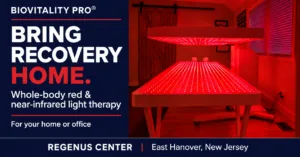
At Regenus Center, we use advanced rejuvenation chambers developed by ARRC LED, engineered specifically for professional photobiomodulation applications.
These systems are designed to deliver light across extensive areas of the body in a controlled, relaxing environment.
Selected systems also feature integrated technologies and programmable protocols that expand the recovery experience beyond conventional red light exposure.
Importantly, effectiveness is not determined by the number of LEDs or the brightness of the light alone. Wavelength, irradiance, exposure duration, treatment area, and consistency all matter.
More light does not automatically mean better results.
It’s about delivering an appropriate dose of light in a way that aligns with the intended application.
Explore advanced whole-body red light therapy at Regenus Center.
From Red Light Therapy Sessions to a BioVitality Protocol™
One of the biggest misconceptions about recovery technology is that an occasional session is necessarily enough to address the cumulative effects of years of demanding living.
Think about how you approach exercise.
You don’t expect to develop strength, endurance or cardiovascular fitness from a single workout. You develop a routine and give your body the opportunity to adapt over time.
We apply a similar philosophy to proactive recovery.
At Regenus Center, a BioVitality Protocol™ is a personalized recovery routine designed to support your body’s energy production, recovery from stress, and ability to adapt to life’s demands — so you can pursue success without sacrificing your health.
Depending on your goals, your routine can incorporate advanced whole-body photobiomodulation alongside complementary recovery technologies, such as infrared sauna, exercise with oxygen therapy, compression therapy, or contrast therapy.
Our four primary BioVitality focus areas are:
- Fatigue & Burnout Recovery: Supporting energy recovery, mental clarity and recuperation from prolonged stress.
- Energy & Inflammation: Supporting cellular function and healthy inflammatory responses.
- Inflammation & Pain: Supporting physical comfort, mobility, and recovery.
- Natural Weight Loss & Body Composition: Complementing the lifestyle practices that support healthy metabolism and body composition.
The objective is to develop a recovery routine around what you’re looking to accomplish, rather than simply choosing a technology because it’s popular.
Why Proactive Recovery Matters More as We Age
As we move through our 40s, 50s, 60s, and beyond, maintaining our physical and mental capacity becomes increasingly important.
Age-related changes in mitochondrial function, muscle mass, and other biological systems can influence how we respond to stress and recover from demanding activity.
But chronological age is only part of the equation.
The way we live, the demands we place on ourselves and the opportunities we create for recuperation also matter.
For many of us, the answer is not necessarily to become less ambitious, exercise less, or give up the activities we love.
It’s to become more intentional about recovery.
Advanced recovery technologies give us additional tools to complement the fundamentals of healthy living.
I believe proactive recovery should become as much a part of our lifestyle as exercise and nutrition.
Because high performance and high capacity are not necessarily the same thing.
You can be performing at a high level while progressively depleting your capacity to sustain it.
Frequently Asked Questions About Red Light Therapy
Does red light therapy really increase energy?
Research suggests that red and near-infrared photobiomodulation can influence mitochondrial activity and ATP production under particular conditions. These cellular effects are different from a guaranteed increase in the energy you feel throughout the day.
Is red light therapy good for inflammation?
Photobiomodulation has demonstrated anti-inflammatory effects in experimental research and certain clinical applications. Results depend on the condition, treatment parameters, and individual response.
How often should I use whole-body red light therapy?
Many recovery routines involve multiple sessions per week. The appropriate frequency depends on the device, dose, individual goals, and response. At Regenus Center, we help you establish a protocol appropriate for your objectives.
Is red light therapy the same as infrared sauna?
No. Photobiomodulation is primarily intended to produce biological effects through light exposure. Infrared sauna primarily uses radiant heat to create a thermal response. They are different technologies that can complement one another.
Is a red light therapy bed better than a panel?
A professionally designed whole-body light therapy chamber can offer extensive body coverage and a convenient reclining experience. Whether a bed or panel is more appropriate depends on its technical specifications, treatment goals, and how it is used.
Is red light therapy safe?
Photobiomodulation is generally well tolerated when used appropriately. People taking photosensitizing medications or managing relevant medical conditions should consult a healthcare professional before beginning. Device-specific safety and eye-protection instructions should always be followed.
Where can I experience advanced red light therapy in Northern New Jersey?
Regenus Center in East Hanover, NJ, specializes in advanced whole-body photobiomodulation using ARRC LED rejuvenation chambers and complementary recovery technologies.
We serve individuals throughout Morris County, Essex County, and surrounding North Jersey communities, including Livingston, Florham Park, Hanover, Parsippany, Chatham and Madison.
Experience What It Means to Put Energy First
You don’t have to wait until you’re exhausted, burned out, or dealing with persistent discomfort to start making recovery a priority.
You can proactively invest in your body’s capacity to recover and respond to the demands of your life.
At Regenus Center, that’s what we’re here to help you do.
Whether you’re new to red light therapy or looking to advance your existing recovery routine, we invite you to experience the next level of whole-body photobiomodulation.
Unlock Your Body’s Resilience.
Schedule your complimentary consultation at Regenus Center and discover how a personalized BioVitality Protocol™ can become part of your lifestyle.
37 Mount Pleasant Avenue, Suite 3
East Hanover, NJ 07936
Call: 862-295-1620
Scientific References
- Hamblin MR. Mechanisms and Mitochondrial Redox Signaling in Photobiomodulation. Photochemistry and Photobiology. 2018;94(2):199–212. DOI: 10.1111/php.12864.
- Hamblin MR. Mechanisms and applications of the anti-inflammatory effects of photobiomodulation. AIMS Biophysics. 2017;4(3):337–361. DOI: 10.3934/biophy.2017.3.337.
This article is for educational purposes and is not intended to diagnose or treat medical conditions.