

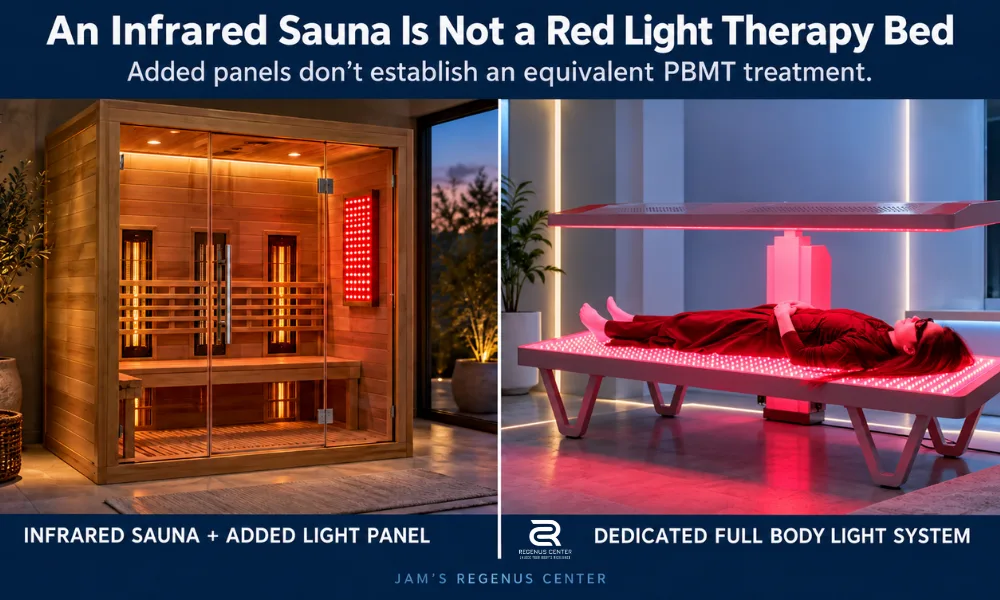
From my conversations at Regenus Center, I believe a significant correction is overdue: people need to understand what a device actually delivers before accepting “red light therapy” as a label.
Infrared Sauna vs Red Light Therapy: The Difference Begins With Heat and Light Delivery
An infrared sauna is designed primarily to heat your body.
Its heating elements commonly emit far infrared radiation, often in a range around 6–14 micrometers, or 6,000–14,000 nanometers. Your body absorbs that energy as heat. The resulting exposure can raise skin temperature, provoke sweating, and, under sufficiently hot conditions, raise core temperature. Those are physiological effects of heat exposure. Research on far infrared sauna and core temperature
Those wavelength numbers describe the radiation—not a temperature setting or how deeply the light penetrates. A sauna’s cabin temperature also depends on heater power, insulation, ventilation, and operating time.
Photobiomodulation, shortened to PBM or PBMT when referring to therapy, uses controlled light exposure to influence biological activity. Researchers commonly study it using visible red and near-infrared light delivered by LEDs or lasers.
Researchers specify wavelength, irradiance at the treatment surface, exposure time, dose, and the treated area. The FDA’s draft PBM guidance describes light applied to alter biological activity at an irradiance that does not induce heating. FDA draft guidance on photobiomodulation devices
A sauna is engineered to produce heat. A PBMT system is engineered to deliver a controlled light exposure without relying on substantial heating.
That distinction does not make infrared saunas inferior. We have an infrared sauna at JAM’s Regenus Center. Heat has its place. I want people to understand which experience they are choosing.
Is an Infrared Sauna the Same as Red Light Therapy?
An infrared sauna’s heating elements do not automatically provide the same exposure as a dedicated red and near-infrared light system.
“Infrared” describes a broad region of the electromagnetic spectrum. It does not identify one treatment, one wavelength, or one biological effect.
For example, 940 nanometers is near infrared. It is a substantially shorter wavelength than the 6,000–14,000 nanometer range commonly associated with far infrared sauna heaters. Yet wavelength alone does not determine whether an exposure produces significant heat. Power, absorption, exposure time, and device design also matter.
When evaluating infrared sauna vs red light therapy, the useful question is: What is this system delivering to my body, and under what conditions?
The words on the brochure cannot answer that. The equipment specifications and treatment protocol should.
What Changes When an Infrared Sauna Has Red Light Panels?
A sauna fitted with red or near-infrared LEDs can expose a person to those wavelengths. The LEDs do not stop emitting potentially useful light because they are inside a sauna.
Photobiomodulation researcher Michael Hamblin has discussed these combination devices and the possibility that adding red and near-infrared LEDs may provide additional physiological benefits. He also distinguishes devices designed to heat tissue, such as infrared saunas, from PBM devices generally designed to avoid substantial heating. Michael R. Hamblin, 2022
But the presence of LEDs indicates a light source—not the quality or equivalence of a treatment.
It does not tell you:
- How much light reaches the body.
- Which areas receive it.
- How evenly that light is distributed.
- How long each area is exposed.
- Whether the delivered exposure resembles a studied PBMT protocol.
Researchers have warned that even matching a stated energy dose is insufficient if power, treatment time, and delivery conditions differ. PBMT can also have a biphasic dose response: more light does not automatically produce a better result. WALT position paper on PBMT parameters and dosing
I would describe a combination device plainly: an infrared sauna with added red or near-infrared LEDs.
If the manufacturer documents the light delivered to the person during actual use, we can evaluate that light exposure on its merits. We cannot assume the addition makes the sauna equivalent to a dedicated full-body PBMT system.
Why Body Coverage Matters
The question is not how impressive a cabin looks when it glows red. The question is what reaches you.
Imagine sitting in a sauna with a light panel behind you or on one wall. Your distance from the panel changes as you move. Some parts of your body face the LEDs; other parts may be shaded.
A system built around exposing a person lying between a lower light bed and an upper canopy has a different arrangement. That arrangement can make broad body coverage easier to organize, but its actual performance still needs to be measured.
This is a central consideration in infrared sauna vs red light therapy: exposing one part of the body to an added panel is not automatically equivalent to delivering a planned light exposure across a much larger treatment area.
Nor does every light bed deliver the same dose. A bed, canopy, panel, and sauna combination all deserve scrutiny.
What Should You Ask Before Buying or Booking?
Before paying for equipment or a session, ask what you will actually receive.
| What to ask | Why it matters |
|---|---|
| Which wavelengths does it emit? | “Infrared” alone does not identify the exposure. |
| What irradiance reaches the body at the actual treatment position? | LED output differs from the light delivered to a person. |
| Which parts of the body receive light? | Coverage depends on placement, distance, and posture. |
| How long is each area exposed, and what is the resulting dose? | Treatment time and dose help define the intervention. |
| What evidence supports the outcome being claimed? | A wavelength or LED count alone does not establish a clinical benefit. |
These are the kinds of parameters researchers report so another person can understand and reproduce a treatment. FDA draft guidance on device parameters
For anyone researching infrared sauna vs red light therapy, these answers are more useful than a long list of benefits borrowed from studies using different equipment or protocols.
Research supporting a particular PBMT application does not automatically validate every device that emits red light.
Where “Advanced Red Light Therapy” Needs to Earn Its Name
I hear advanced used freely in this market. Sometimes it refers to thoughtful engineering and treatment delivery. Sometimes it refers to more LEDs, a dramatic photograph, or a higher price.
“Advanced” is not, by itself, a scientific classification.
A credible explanation should tell you what the system was designed to do, how it delivers light across the intended treatment area, what its measured output is at the body, and what evidence supports the outcomes being discussed, even though “at the body” measurements are rarely given by manufacturers because most of the manufacturers work on a more-is-better mentality and give the output at the point of the LED, therefore forcing everyone to do the same, at risk of looking like they’ve produced an inferior device.
In the infrared sauna vs red light therapy conversation, calling something “advanced” should lead to a clearer explanation of its capabilities.
At Regenus Center, our light systems are central to the BioVitality Protocol™ because we want people to have a dedicated, guided experience built around rest and recovery.
Lying down and resting completely is part of how we deliver that experience.
When someone comes in tired, sore, or feeling that their recovery never catches up with what life asks of them, I want to talk about their energy and their whole pattern of living.
I also want to be exact about the technology we use. An infrared sauna session and a dedicated light session can both fit into that conversation. Calling them interchangeable prevents people from making an informed choice. They are not.
Closing the Light Sauna Gap
I call this misunderstanding the Light Sauna Gap: the gap between what people assume an infrared sauna delivers and what a dedicated photobiomodulation system is designed to deliver.
The word infrared has been used to describe everything from a heating cabin to a near-infrared LED. Add red lights to the cabin, and it becomes harder for a buyer to tell the difference.
We need clearer explanations.
When people ask me about infrared sauna vs red light therapy, I want them to leave knowing how to evaluate both: the purpose of the exposure, the light delivered, the body coverage, and the protocol.
If you enjoy an infrared sauna, enjoy it for what it does. If it also has red and near-infrared LEDs, great; it’s beneficial. But if you want the full results of advanced red light therapy photobiomodulation, ask for the specifications of that light exposure. You’ll find that the infrared sauna won’t deliver that, so come to Regenus Center.
If your goal is dedicated full-body photobiomodulation, or whole body, look for a system and protocol designed to deliver it.
That was the moment of surprise I saw so often at Regenus Center: someone arrived expecting an infrared sauna, then discovered that the light systems were something else entirely.
Know which experience you are getting. Your time, money, and recovery deserve that clarity.
Scientific References
-
- Hamblin MR. “Traditional or Infrared Saunas and Photobiomodulation: What Do They Have in Common?” Photobiomodulation, Photomedicine, and Laser Surgery. 2022;40(9):595–596. Michael R. Hamblin, 2022
- Jenkins et al. “Far-infrared sauna exposure at 65°C elevates core temperature.” Experimental Physiology. 2026. PMC
- World Association for Photobiomodulation Therapy. “Photobiomodulation therapy in management of cancer therapy-induced side effects: WALT position paper 2022.” Frontiers in Oncology. 2022. Its dose recommendations concern specific clinical uses; they are not general prescriptions for full-body treatments. Frontiers in Oncology
- U.S. Food and Drug Administration. “Photobiomodulation (PBM) Devices—Premarket Notification [510(k)] Submissions.” Draft guidance, cited here for its terminology and discussion of device parameters, not as a final regulatory standard. FDA