How Photobiomodulation Therapy Supports Cellular Energy
by John Allen Mollenhauer, “JAM, Founder Performany, Regenus Center.
In recent years, photobiomodulation therapy (PBMT) has gained significant attention for its potential to support cellular energy production and recovery.
Often referred to as red and near-infrared light therapy, PBMT involves exposing tissue to specific wavelengths of light that can penetrate the skin and interact with cellular structures, particularly mitochondria.
Understanding how PBMT works requires starting with the fundamental concept of cellular energy metabolism.
The Role of Mitochondria in Cellular Energy
Mitochondria are often described as the power plants of the cell.
Their primary role is producing adenosine triphosphate (ATP), the molecule that fuels nearly every biological function, including:
• muscle contraction
• nerve signaling
• cellular repair
• protein synthesis
• immune activity
ATP is generated through oxidative phosphorylation, a process that occurs in the mitochondrial electron transport chain.
When mitochondrial function becomes impaired, ATP production can decline, contributing to fatigue, slower recovery, and impaired cellular repair.
How PBMT Interacts with Mitochondria
Photobiomodulation works through a process known as photochemical signaling.
Certain molecules within mitochondria can absorb photons of light within specific wavelengths, particularly in the red (600–700 nm) and near-infrared (780–1100 nm) ranges.
One of the most studied targets is the enzyme cytochrome c oxidase, a key component of the mitochondrial electron transport chain.
When this enzyme absorbs light energy, several biological responses may occur:
• improved mitochondrial respiration
• increased electron transport efficiency
• greater ATP synthesis
• enhanced cellular signaling
These changes can improve cellular energy availability.
PBMT and ATP Production
Several studies have demonstrated that PBMT can increase ATP production in cells.
For example:
Karu (1999) described the interaction between red light and mitochondrial respiratory chain components, showing increased metabolic activity following PBMT exposure.
Later studies confirmed that photobiomodulation can increase mitochondrial membrane potential and ATP generation.
This increase in ATP availability may help support processes such as:
• tissue repair
• muscle recovery
• neurological function
• immune regulation
However, it is important to recognize that PBMT is not a universal energy regenerator. Instead, it appears to support cellular efficiency within existing metabolic systems.
PBMT and Cellular Signaling
Beyond ATP production, PBMT also influences cellular signaling pathways.
Research suggests that photobiomodulation may stimulate signaling molecules involved in:
• tissue regeneration
• inflammation modulation
• oxidative stress response
• gene expression
This signaling activity may explain why PBMT has been studied across a wide range of clinical applications, including wound healing, neurological health, and musculoskeletal recovery.
The Importance of PBMT Dosing
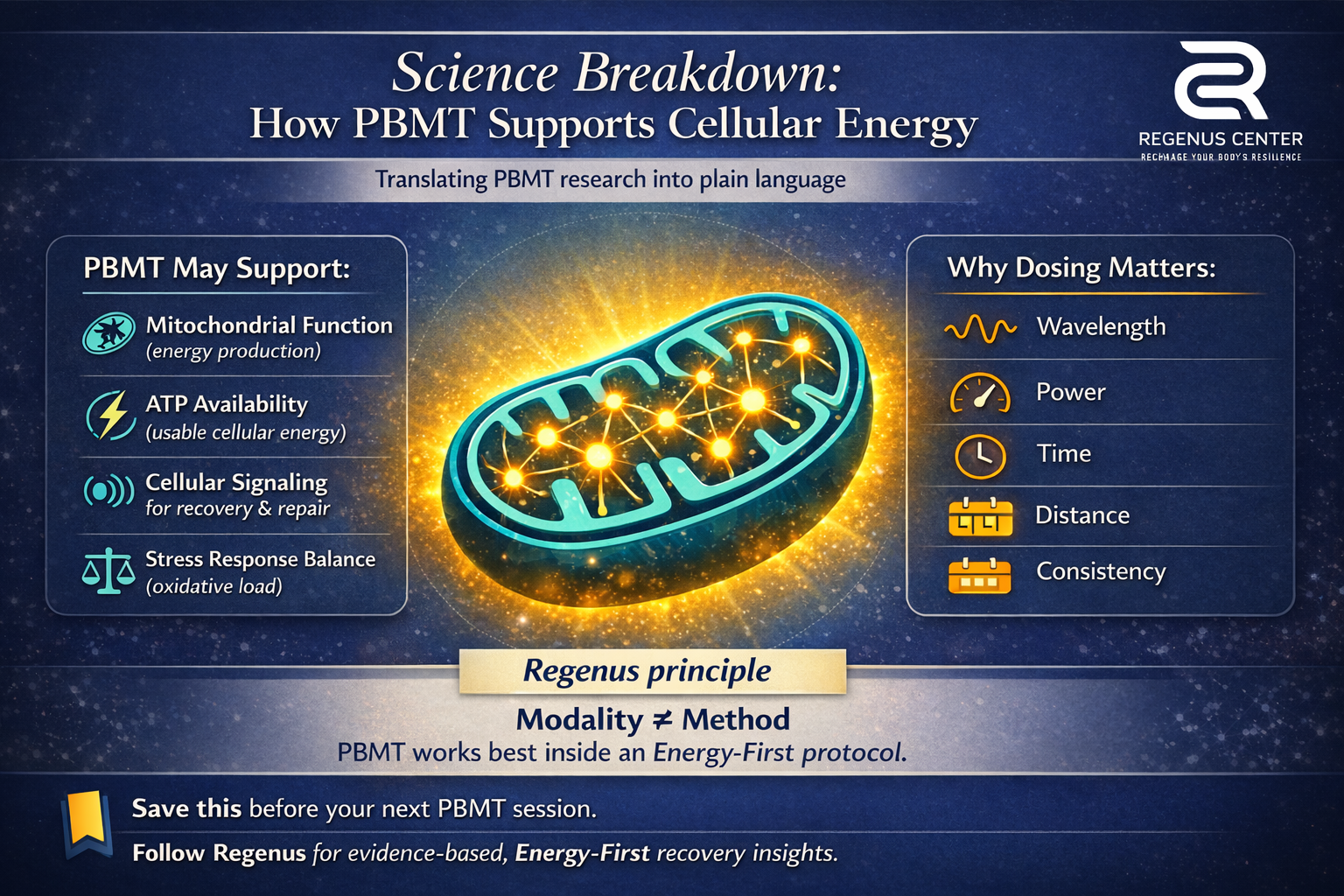
One of the most important factors in photobiomodulation therapy is dosimetry.
Unlike medications, PBMT responses are highly dependent on treatment parameters.
The biological response can vary based on:
• wavelength
• power density
• exposure time
• treatment distance
• treatment frequency
This phenomenon is known as the biphasic dose response, meaning that too little light may produce no effect, while too much may reduce effectiveness.
Proper dosing is therefore essential for achieving consistent outcomes.
Modality vs Method
A key principle emphasized in energy-based recovery systems is that a modality alone does not constitute a method.
PBMT is a powerful biological tool, but it works best when integrated into a broader framework that addresses how the body re/generates and restores energy in the wake of the exposome of stress.
At Regenus Center, PBMT is used within an Energy-First protocol designed to support cellular function, recovery, and metabolic resilience, which is core to a healthy, high Performance Lifestyle®.
This approach focuses on restoring the biological conditions that allow the body’s energy systems to function efficiently.
PBMT in the Context of Recovery Science
Recovery science increasingly recognizes that performance and resilience depend on the body’s ability to produce and manage energy regenerated at the cellular level.
Photobiomodulation is among several, if not the primary, emerging technologies that can support this process.
While research continues to evolve, current evidence suggests PBMT may support:
• mitochondrial respiration
• ATP production
• cellular repair signaling
• oxidative stress balance
These effects may contribute to improved recovery capacity and cellular resilience.
References
Hamblin MR. Mechanisms and applications of the anti-inflammatory effects of photobiomodulation. AIMS Biophysics. 2017.
Karu T. Primary and secondary mechanisms of action of visible to near-IR radiation on cells. Journal of Photochemistry and Photobiology B. 1999.
Chung H et al. The nuts and bolts of low-level laser therapy. Annals of Biomedical Engineering. 2012.
de Freitas LF, Hamblin MR. Proposed mechanisms of photobiomodulation. Photochemical & Photobiological Sciences. 2016.