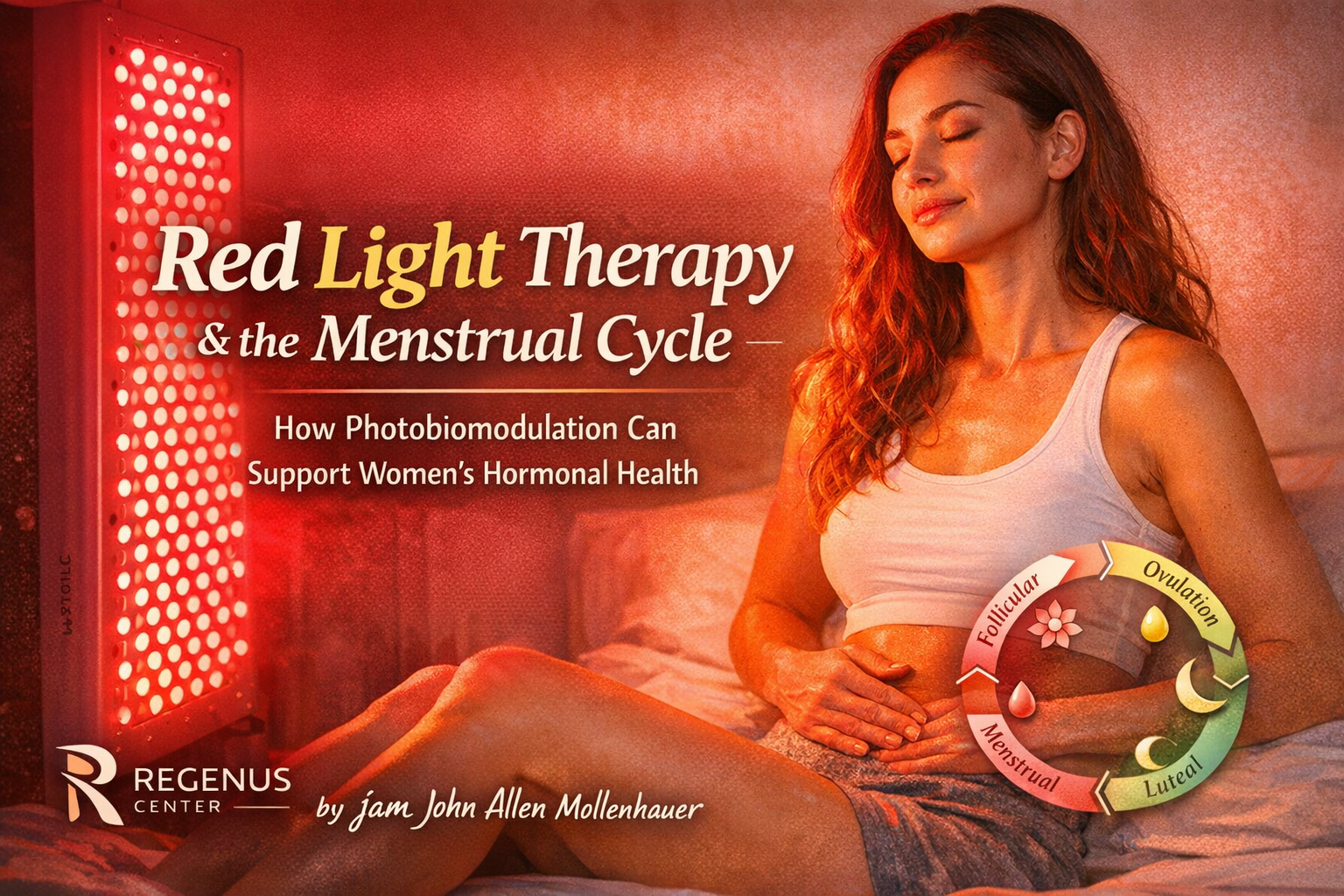
Red Light Therapy for the Menstrual Cycle: An Energy-First Approach to Hormonal Health
How photobiomodulation supports rhythm, recovery, and regulation
By JAM (John Allen Mollenhauer), founder of Regenus Center
Schedule a complimentary consultation at any time.
Introduction: What If It’s Not Just Hormones?
Most conversations around the red light therapy menstrual cycle connection focus on hormones.
Balance estrogen. Regulate progesterone. Manage PMS.
But after more than 50,000 sessions at Regenus Center, I’ve seen something different:
👉 It’s rarely just a hormone issue.
👉 It’s an energy issue first.
When the body is running in energy debt, the menstrual cycle is one of the first systems to reflect it.
And that’s where red light therapy for the menstrual cycle becomes a powerful upstream solution—not by forcing change, but by restoring the system that allows balance to happen naturally.
What Is Red Light Therapy (Photobiomodulation)?
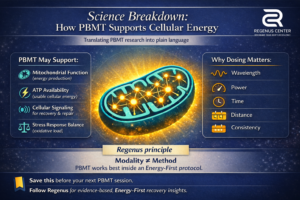
Red light therapy—also known as photobiomodulation (PBM)—uses wavelengths typically in the 630–660 nm (red) and 810–880 nm (near-infrared) range to stimulate cellular activity.
At the core of this process is the mitochondria.
PBM interacts with cytochrome c oxidase, improving mitochondrial respiration and ATP production (Karu, 2008; Hamblin, 2017).
This leads to:
- Increased ATP (cellular energy)
- Improved microcirculation
- Reduced oxidative stress
- Enhanced tissue repair
📚 References:
Karu TI. (2008). Mitochondrial signaling in mammalian cells is activated by red and near-IR radiation. Photochemistry and Photobiology.
Hamblin MR. (2017). Mechanisms and applications of the anti-inflammatory effects of photobiomodulation. AIMS Biophysics.
Why the Menstrual Cycle Is Energy-Dependent
The menstrual cycle is a bioenergetically demanding process involving:
- Ovarian follicle development
- Endometrial growth and shedding
- Hormonal signaling via the HPO axis
All of these require adequate mitochondrial function and oxygen delivery.
When energy production is impaired, the body prioritizes basic functions over reproduction—a concept supported by research linking metabolic stress to menstrual irregularities (Warren & Perlroth, 2001).
📚 Reference:
Warren MP, Perlroth NE. (2001). The effects of intense exercise on the female reproductive system. Journal of Endocrinology.
How Red Light Therapy Supports the Menstrual Cycle
1. Improves Blood Flow to Reproductive Organs
PBM enhances nitric oxide release and vasodilation, increasing microcirculation (de Freitas & Hamblin, 2016).
Improved blood flow supports:
- Oxygen delivery
- Nutrient transport
- Endometrial function
📚 Reference:
de Freitas LF, Hamblin MR. (2016). Proposed mechanisms of photobiomodulation. IEEE Journal of Selected Topics in Quantum Electronics.
2. Reduces Menstrual Pain and Inflammation
Low-level laser therapy (LLLT), a form of PBM, has demonstrated effectiveness in reducing pain and inflammation by modulating prostaglandins and cytokines (Bjordal et al., 2006).
This is particularly relevant for:
- Dysmenorrhea
- Pelvic discomfort
- Muscle tension
📚 Reference:
Bjordal JM et al. (2006). A systematic review of low-level laser therapy in pain management. The Lancet.
3. Supports Hormonal Regulation via the HPO Axis
PBM may influence neuroendocrine signaling by improving cellular energy and reducing stress signaling pathways (Avci et al., 2013).
This supports:
- Hypothalamic signaling
- Pituitary function
- Ovarian responsiveness
📚 Reference:
Avci P et al. (2013). Low-level laser therapy (LLLT) in skin: stimulating, healing, restoring. Seminars in Cutaneous Medicine and Surgery.
4. Enhances Mitochondrial Function and Fertility Potential
Mitochondrial health is directly tied to reproductive outcomes, particularly oocyte quality.
PBM improves mitochondrial efficiency and reduces oxidative stress, which are critical for reproductive tissue health (Hamblin, 2017).
📚 Reference:
Hamblin MR. (2017). Photobiomodulation or low-level laser therapy. Journal of Biophotonics.
5. Regulates the Nervous System
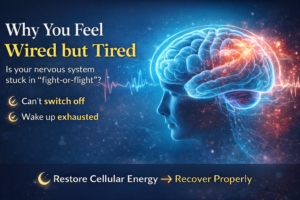
Chronic stress disrupts the menstrual cycle via cortisol and sympathetic dominance.
PBM has been shown to modulate the autonomic nervous system and reduce stress-related inflammation (Zhao et al., 2012).
This supports:
- Parasympathetic activation
- Hormonal rhythm stability
- Reduced PMS symptoms
📚 Reference:
Zhao H et al. (2012). Photobiomodulation therapy for neurological disorders. Neuroscience Letters.
A JAM Insight: The Cycle Is a Performance Rhythm
Here’s what I’ve learned, not just from science—but from real-world application.
Women don’t want to “manage symptoms.”
They want:
- Predictability
- Energy
- Stability
- Alignment
And that’s how I frame the red light therapy menstrual cycle conversation:
👉 The cycle is not the problem
👉 It’s a reflection of system performance
How We Apply This at Regenus Center
We don’t isolate red light therapy—we integrate it.
Our Energy-First Pathway includes:
- Cellular restoration (PBM)
- Circulation + oxygenation
- Nervous system regulation
- Lifestyle precision
For menstrual support, red light therapy for the menstrual cycle is applied:
- Locally (pelvic region)
- Systemically (full-body exposure)
- Consistently across cycles
Because adaptation requires repetition.
Is It Safe?
Red light therapy is widely regarded as safe when used correctly (Hamblin, 2017).
- Non-invasive
- No ionizing radiation
- Minimal side effects
However:
- Use caution during pregnancy
- Use clinically validated systems
Final Thought: This Is About System Restoration
If you’re dealing with irregular cycles, pain, or fatigue:
It’s easy to assume:
👉 “Something is wrong with my hormones.”
But more often:
👉 The system doesn’t have the energy to regulate itself.
That’s why the connection between red light therapy and the menstrual cycle matters.
It’s not about forcing outcomes.
It’s about restoring the system that creates them.
Call to Action
If you’re experiencing challenges with your cycle:
👉 It may not be hormonal
👉 It may be energetic
Experience red light therapy for the menstrual cycle at Regenus Center in East Hanover, NJ
Or begin building your own energy-first strategy today.
Full Scientific Reference List
- Karu TI. (2008). Mitochondrial signaling in mammalian cells is activated by red and near-IR radiation. Photochemistry and Photobiology.
- Hamblin MR. (2017). Mechanisms and applications of photobiomodulation. AIMS Biophysics.
- de Freitas LF, Hamblin MR. (2016). Proposed mechanisms of photobiomodulation. IEEE Journal.
- Bjordal JM et al. (2006). Low-level laser therapy in pain management. The Lancet.
- Avci P et al. (2013). LLLT mechanisms and clinical applications. Seminars in Cutaneous Medicine.
- Zhao H et al. (2012). Photobiomodulation therapy for neurological disorders. Neuroscience Letters.
- Warren MP, Perlroth NE. (2001). Exercise and the female reproductive system. Journal of Endocrinology.