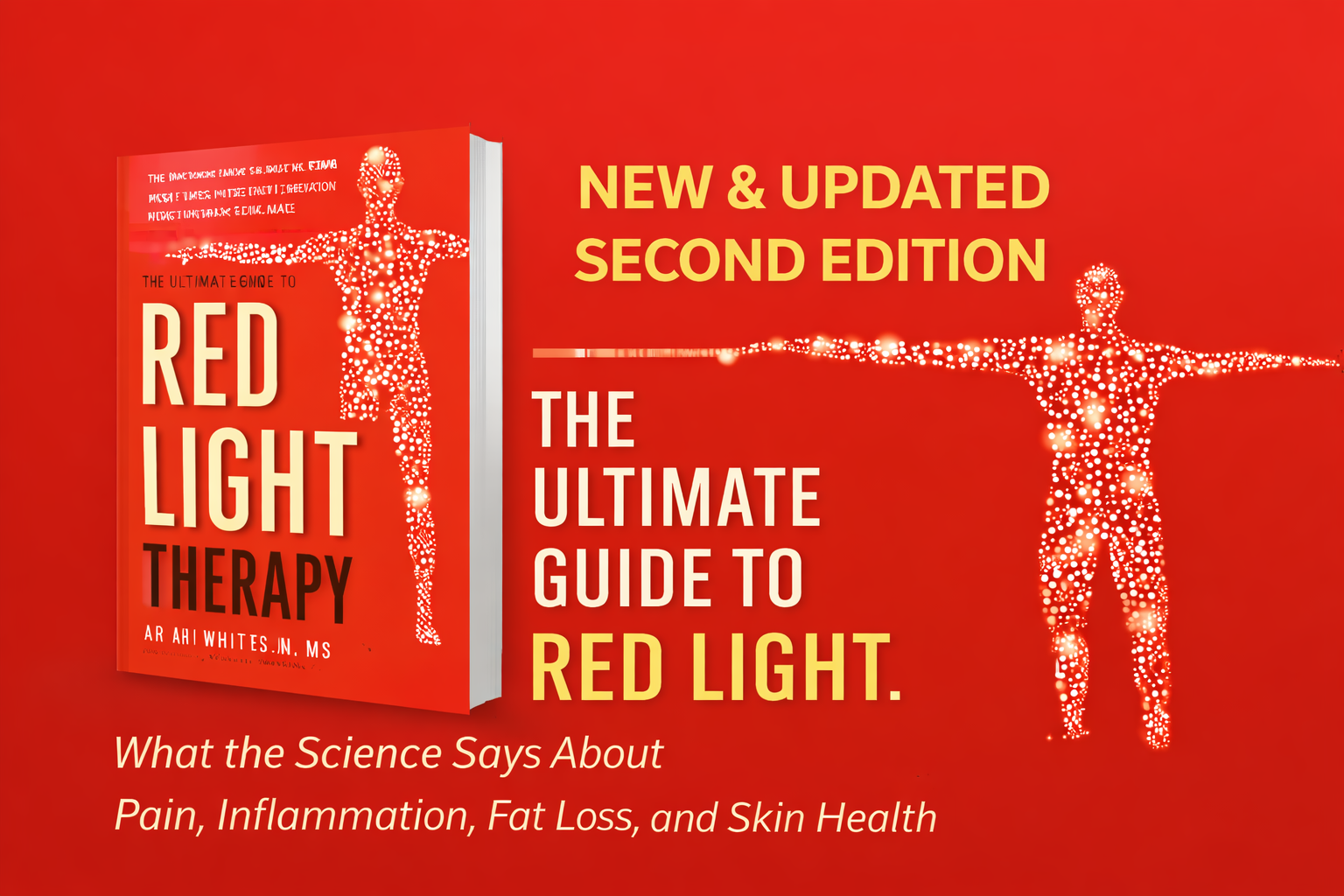
What The Ultimate Guide to Red Light Therapy Is Making Clear About How Photobiomodulation Changes the Body
With the recent release of The Ultimate Guide to Red Light Therapy, one thing has become increasingly clear:
Red light therapy—more accurately known as photobiomodulation (PBM)—is no longer a fringe wellness trend. It is a scientifically validated method for influencing how the human body produces energy, manages inflammation, repairs tissue, and restores function.
In his newly released book, health science researcher Ari Whitten does an exceptional job compiling decades of research into one comprehensive, accessible resource. It’s actually the second, revised and updated release of the book.
What makes the book particularly valuable is that it doesn’t just explain that red light therapy works—but why it works, and what’s actually happening inside the body when it’s applied correctly.
For those paying attention, the implications are significant.
The Central Theme of the Book: Energy Is the Root Issue
One of the most important ideas reinforced throughout The Ultimate Guide to Red Light Therapy is this:
At the core of pain, inflammation, slow recovery, stubborn fat, skin aging, and declining vitality is a cellular energy problem.
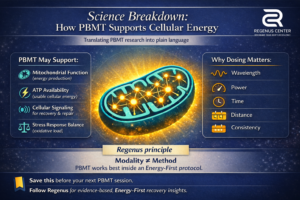
Photobiomodulation works through multiple, wavelength-specific pathways. Red and near-infrared light improve cellular energy by supporting mitochondrial function and ATP production. Infrared wavelengths enhance cellular efficiency by interacting with structured water and charge fields around the cell membrane. Other wavelengths, such as green light, influence blood flow and nervous system signaling through non-mitochondrial mechanisms. Together, these effects support recovery, resilience, and overall function.
Red and near-infrared light interact with cytochrome c oxidase, a key enzyme in the mitochondrial respiratory chain. Research cited throughout the book shows that this interaction can:
-
Increase ATP production
-
Improve oxygen utilization
-
Reduce oxidative stress
-
Improve cellular signaling related to repair and regeneration
These mechanisms are well documented in the scientific literature (Karu, 2010; Hamblin, 2016), and Ari does an excellent job translating complex biochemistry into practical understanding.
When cells regain the ability to produce energy efficiently, the body shifts from survival mode into repair mode.
Why Pain and Inflammation Respond So Consistently
A major reason people seek red light therapy is to relieve pain, inflammation, stiffness, and lingering injuries.
As outlined in The Ultimate Guide to Red Light Therapy, PBM has been shown to influence inflammatory pathways by:
-
Reducing pro-inflammatory cytokines
-
Improving local circulation and oxygen delivery
-
Supporting nerve health and tissue repair
Systematic reviews and clinical trials cited in the book demonstrate benefits for joint pain, arthritis, muscle soreness, and injury recovery—often without the side effects associated with medications (Bjordal et al., 2006; Chung et al., 2012).
This explains why many people don’t experience only temporary relief but rather cumulative improvement over time.
Skin, Collagen, and Visible Body Changes
Another area extensively covered in the book is skin health and body composition.
Red and near-infrared light have been shown to stimulate fibroblast activity, increasing collagen and elastin production—key structural proteins responsible for skin firmness and elasticity.
Research referenced in the book points to improvements in:
-
Skin tone and texture
-
Fine lines and sagging
-
Wound healing and scar remodeling
In addition, PBM has been studied for its effects on fat metabolism and circulation in stubborn areas, which may help explain why some people notice changes in body composition when light therapy is applied consistently and at the appropriate dose (Avci et al., 2013). Learn more here.
Recovery, Energy, and Why Sleep Alone Isn’t Enough
The research outlined in The Ultimate Guide to Red Light Therapy makes clear that cellular energy availability plays a central role in recovery and repair. From that foundation, one conclusion becomes obvious: recovery is not passive.
Sleep is essential, but in today’s fast-paced performance culture, it is often insufficient. Photobiomodulation accelerates recovery by restoring cellular energy-regeneration capacity—something rest alone cannot always accomplish.
This helps explain why people often report:
-
Improved daily energy
-
Faster recovery from training and physical stress
-
Greater resilience to mental and emotional load
This is the bridge between symptom relief and improved vitality and performance.
The Question of Dose, Scale, and Whole-Body Exposure
One important distinction—acknowledged in the book and reinforced through real-world application—is that dose and scale matter.
Portable devices play an important role, particularly for accessibility, and Ari appropriately focuses on their use at home. However, both research and clinical experience suggest that whole-body exposure using higher-powered systems delivers more consistent and systemic effects due to:
-
Greater tissue coverage
-
Higher total energy delivery
-
More complete physiological signaling
This is where the educational value of this book can have its greatest impact. Portable devices play an important role, but dose-optimized, whole-body commercial systems enable the application of photobiomodulation at a scale that produces deeper and more consistent physiological changes.
Ari is writing primarily for readers who are most likely to start with an at-home, portable device—and that makes sense. I’ve followed this same advice myself and continue to use a portable device, originally suggested by Ari Whitten, where appropriate. At the same time, having built and operated a full-scale regeneration facility and facilitated more than 56,000 sessions to date, with a dose optimized system (guided by his co-author, scientific bellwether in the red light therapy/photobiomodulation field, Dr. Michael Hamblin, PhD of MIT)… I’ve seen firsthand that commercial-grade systems deliver a level of power, coverage, and consistency that portable devices simply can’t match.
I note that the statement on NovoTHOR Irradiance compared to other beds on page 189 of the book does not account for “all other beds,” notably ARRC LED’s ATP, which was carefully considered and delivered at Regenus Center.
That said, I fully support the use of portable devices when they align with an individual’s needs, access, and budget. What I believe is missing from the book is a deeper review of the whole-body pods as the author refers to them. It is worth acknowledging that substantial differences in outcomes depend on dose, scale, number of wavelengths, and delivery environment.
What the Book Ultimately Makes Clear
The Ultimate Guide to Red Light Therapy makes one thing unmistakable:
Photobiomodulation works because it supports something fundamental—the body’s ability to produce energy, reduce inflammation, and repair itself.
Education is the first step.
Proper application is the second.
When the two come together, people don’t just feel better—they function better.
That’s the real promise of red light therapy when it’s understood and used correctly.
This book is awesome in so many aspects. A recommended read, I learned a great deal and deepened my understanding across many areas. My critique is not a criticism; it is simply sharing an insight about an aspect of the photobiomodulation field that you discover when you’ve been immersed in the field for 8 years, in the business of whole-body, not just portable devices.
Selected Scientific References
Karu, T. I. (2010).
Mitochondrial signaling in mammalian cells activated by red and near-infrared radiation. Photochemistry and Photobiology, 84(5), 1091–1099.
→ Demonstrates light interaction with cytochrome c oxidase and mitochondrial signaling mechanisms.
Hamblin, M. R. (2016).
Mechanisms and applications of the anti-inflammatory effects of photobiomodulation. AIMS Biophysics, 3(3), 337–361.
→ Details ATP production, nitric oxide dissociation, and reductions in oxidative stress.
Bjordal, J. M., Johnson, M. I., Iversen, V., Aimbire, F., & Lopes-Martins, R. A. B. (2006).
A systematic review of low-level laser therapy with location-specific doses for pain from chronic joint disorders. Australian Journal of Physiotherapy, 52(2), 89–98.
→ Reviews clinical evidence supporting pain reduction via photobiomodulation.
Chung, H., Dai, T., Sharma, S. K., Huang, Y.-Y., Carroll, J. D., & Hamblin, M. R. (2012).
The nuts and bolts of low-level laser (light) therapy. Annals of Biomedical Engineering, 40(2), 516–533.
→ Comprehensive overview of PBM mechanisms, dosimetry, and therapeutic applications.
Avci, P., Gupta, A., Sadasivam, M., Vecchio, D., Pam, Z., Pam, N., & Hamblin, M. R. (2013).
Low-level laser (light) therapy for fat layer reduction: A comprehensive review. Lasers in Surgery and Medicine, 45(6), 349–357.
→ Explores photobiomodulation’s effects on adipocytes, fat metabolism, and body contouring.
Poyton, R. O., & Ball, K. A. (2011).
Therapeutic photobiomodulation: Nitric oxide and cytochrome c oxidase. Mitochondrion, 11(5), 737–743.
→ Explains nitric oxide inhibition of mitochondrial respiration and how light restores electron transport efficiency.