Why “Healthy Habits” Can Make Chronic Fatigue Worse
Modern health culture promotes a simple formula:
Exercise more.
Eat less.
Push harder.
For many people, those habits work.
But for individuals experiencing chronic exhaustion, burnout, or mitochondrial fatigue, adding more stress can actually deepen the problem.
This isn’t a failure of discipline.
It’s a failure of energy physiology.
The Hidden Factor: Cellular Energy
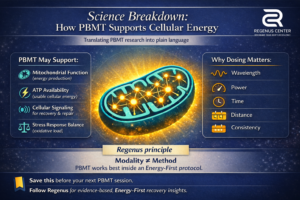
Every function in the human body runs on adenosine triphosphate (ATP), the universal cellular energy molecule produced inside mitochondria.
When mitochondrial output declines, the body’s ability to tolerate stress declines as well.
Research has shown that mitochondrial dysfunction is associated with:
• chronic fatigue syndrome
• metabolic dysfunction
• overtraining syndrome
• neurodegenerative diseases
When energy production is impaired, the body shifts into a conservation mode, prioritizing survival over performance.
Adding more stress in that state often backfires.
Why Healthy Habits Can Backfire
Many popular wellness practices are actually physiological stressors.
That doesn’t mean they’re bad.
It means they require energy to adapt to.
For example:
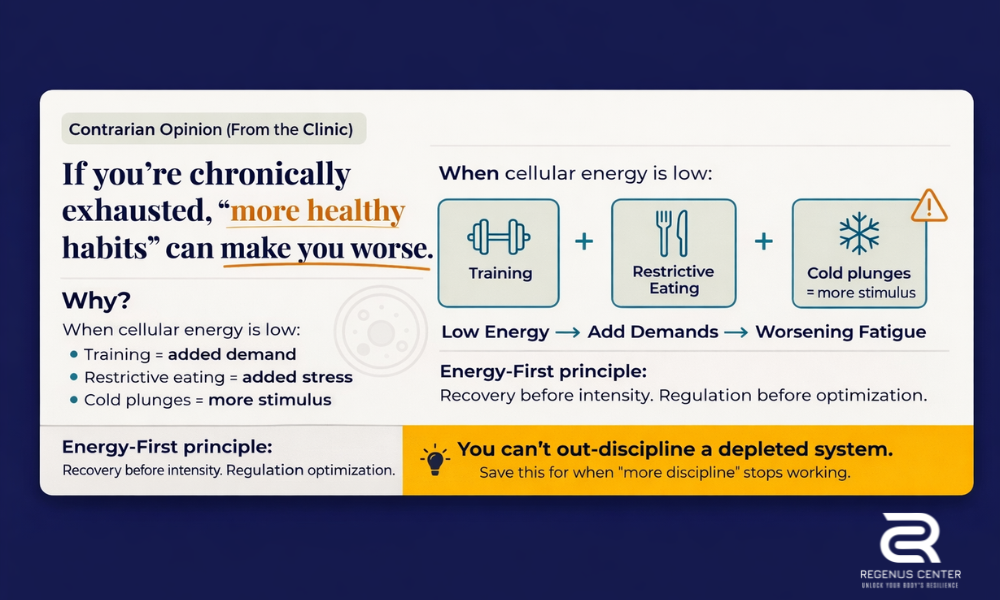
Training
Exercise stimulates mitochondrial growth and metabolic adaptation.
But it also increases energy demand and oxidative stress during recovery.
When recovery capacity is low, exercise can deepen fatigue.
Research on overtraining syndrome demonstrates that excessive training without sufficient recovery leads to prolonged fatigue and hormonal disruption.
Restrictive Dieting
Caloric restriction can improve metabolic health in certain contexts.
But severe or prolonged energy restriction reduces mitochondrial output and thyroid activity, particularly in already fatigued individuals.
Low energy availability has been strongly linked with fatigue and impaired physiological function.
Cold Exposure
Cold plunges stimulate norepinephrine release and mitochondrial adaptation.
But they also trigger the sympathetic nervous system and require metabolic energy to maintain temperature.
If cellular energy is already depleted, additional cold stress can exacerbate exhaustion.
The Energy-First Principle
A more sustainable approach to performance begins with restoring cellular energy before increasing demands.
This concept aligns with emerging research on bioenergetics and mitochondrial health.
Key strategies often include:
• optimizing sleep quality
• supporting mitochondrial function
• restoring nervous system balance
• structured recovery cycles
Only once energy production improves should higher-intensity stressors—like aggressive training or cold exposure—be layered in.
This sequence allows the body to adapt rather than collapse under demand.
The Real Lesson
Many people believe they simply need more discipline.
But biology doesn’t work that way.
You cannot out-discipline physiology.
When energy production is compromised, the solution isn’t pushing harder.
The solution is rebuilding the system.
Recovery before intensity.
Regulation before optimization.
That’s how sustainable performance begins.
Bjordal JM et al.
A systematic review of photobiomodulation therapy in mitochondrial function.
Photomedicine and Laser Surgery.
Myhill S, Booth NE, McLaren-Howard J.
Chronic fatigue syndrome and mitochondrial dysfunction.
International Journal of Clinical and Experimental Medicine.
Meeusen R et al.
Prevention and treatment of overtraining syndrome.
European Journal of Sport Science.
Lane N.
Power, Sex, Suicide: Mitochondria and the Meaning of Life.
Nicolson GL.
Mitochondrial dysfunction and chronic disease.
International Journal of Clinical Medicine.