Why You Feel Wired but Tired: The Nervous System Problem Behind Poor Sleep
Most people aren’t tired because they did too much. They’re tired because their system never switched off.
Many people assume fatigue is simple:
If you feel exhausted, you must need more sleep.
But a growing number of people experience a different problem entirely.
They sleep… yet wake up feeling unrestored.
They are tired but mentally alert.
Their mind races at night.
They wake around 2–3 am.
Sleep feels shallow.
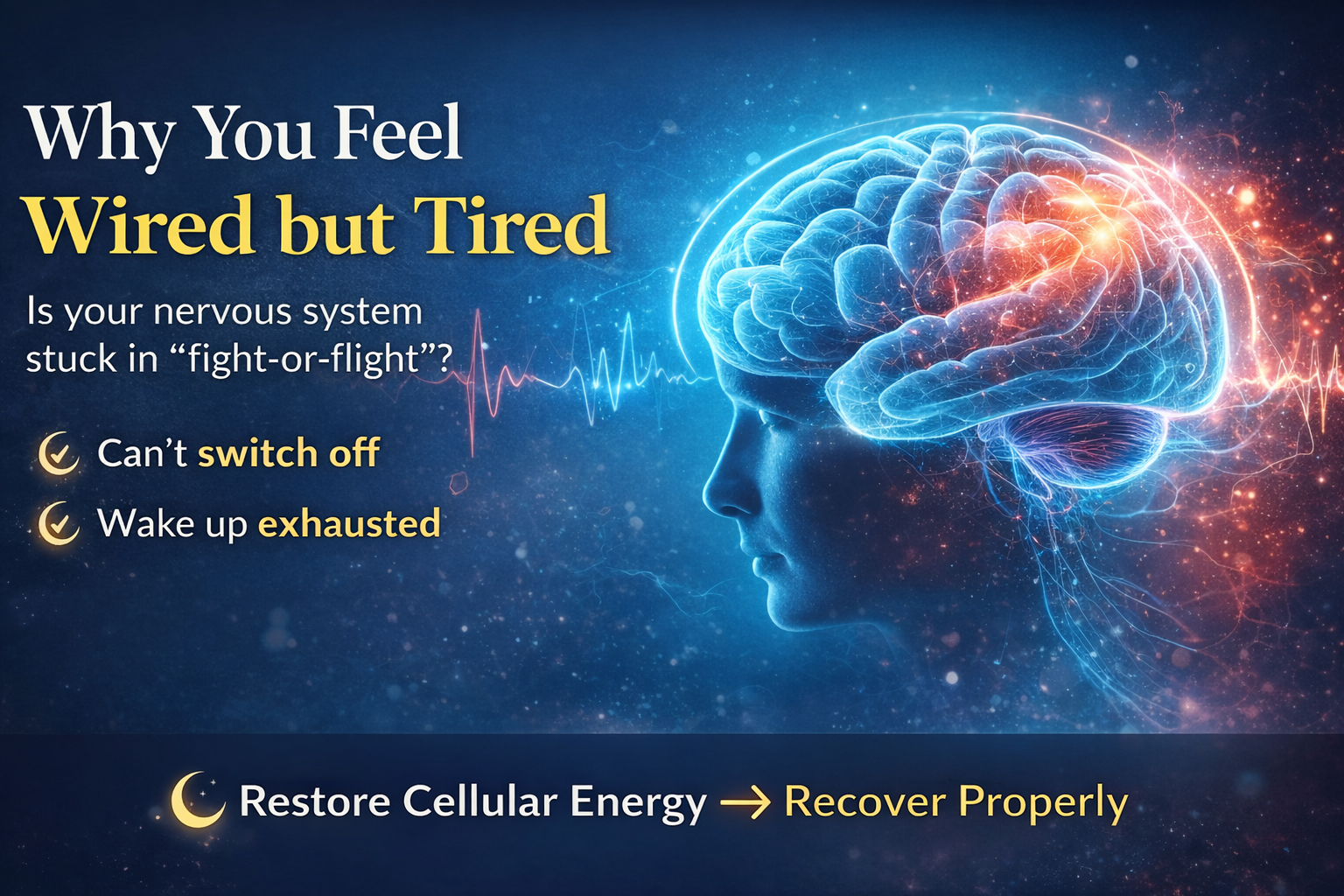
This experience is often described as being “wired but tired.”
And it is increasingly common in modern life.
The reason is often misunderstood.
Because the problem isn’t always sleep.
The problem is the body’s ability to downshift.
What Does “Wired but Tired” Mean?
The phrase wired but tired describes a paradoxical state where someone feels:
-
mentally alert but physically exhausted
-
unable to relax even when fatigued
-
restless at night despite needing sleep
-
overwhelmed by stress
This state is commonly associated with sympathetic nervous system dominance, also known as being stuck in fight-or-flight mode.
When the nervous system remains activated for too long, the body struggles to transition into the restorative state required for recovery.
You can’t recover in the same state that exhausted you.
When the Nervous System Gets Stuck in Fight-or-Flight
The human nervous system operates through two major branches of the autonomic nervous system:
Sympathetic Nervous System
Responsible for:
-
alertness
-
Focus under pressure
-
mobilizing energy
-
the fight-or-flight response
Parasympathetic Nervous System
Responsible for:
-
relaxation
-
digestion
-
cellular repair
-
immune function
-
deep sleep
Under healthy conditions, the body moves fluidly between these states.
Activation occurs when needed.
Recovery follows afterward.
But modern life can disrupt this rhythm.
Continuous stimulation from:
-
digital devices
-
chronic psychological stress
-
economic pressures
-
information overload
-
poor recovery habits
can keep the nervous system in a prolonged state of activation.
Researchers often describe this as chronic sympathetic dominance or autonomic imbalance.
(Sapolsky, 2004; McEwen, 2007)
Restore cellular energy — and suddenly the nervous system remembers how to relax.
Why Poor Nervous System Regulation Affects Sleep
When the nervous system cannot downshift properly, several biological processes begin to change.
Research shows chronic stress activation can alter:
-
cortisol rhythms
-
inflammatory signaling
-
sleep architecture
-
heart-rate variability
(McEwen & Wingfield, 2003)
This is why people with nervous system dysregulation often experience:
-
light or fragmented sleep
-
early morning wakeups
-
reduced deep sleep
-
persistent fatigue
The body attempts to recover…
but never fully reaches the physiological state required for repair.
The Science of Downshifting the Nervous System
Recovery requires the nervous system to transition from sympathetic activation to parasympathetic regulation.
This shift is sometimes called downshifting.
Downshifting allows the body to enter the biological state responsible for:
-
tissue repair
-
hormone balance
-
immune regulation
-
deep sleep
-
nervous system recovery
Stephen Porges’ Polyvagal Theory explains how the nervous system shifts between states of activation, regulation, and safety.
(Porges, 2011)
According to this research, the body requires signals of safety and stability to activate restorative physiology.
Without those signals, the system may remain partially activated even during sleep.
The goal isn’t to shut your brain off.
The goal is to stop your brain from running the show.
Is Meditation the Answer?
Many traditions attempt to achieve this shift through practices like:
-
meditation
-
breathwork
-
relaxation training
These practices can help quiet the mind and reduce activity in the brain’s default mode network, which is associated with rumination and mental overactivity.
(Brewer et al., 2011)
But there is another perspective that is often overlooked.
Instead of simply trying to quiet the mind…
You can learn to get into the right relationship with your brain.
This means developing the ability to:
Use your mind deliberately.
Instead of being pulled around by it.
When this happens, the nervous system can shift out of chronic activation more easily.
The Missing Factor: Cellular Energy
Nervous system regulation is not purely psychological.
It is also biological.
Your brain and nervous system require a tremendous amount of cellular energy to function properly.
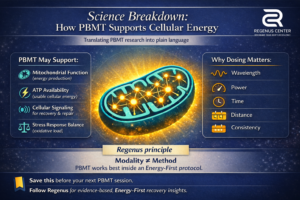
At the cellular level, that energy comes from mitochondria, the structures responsible for producing ATP.
ATP is the primary energy currency used by cells.
The brain, although accounting for only about 2% of body weight, consumes approximately 20% of the body’s energy.
(Ames, 2000)
When mitochondrial energy production declines, nervous system stability can follow suit.
Research has linked mitochondrial function to:
-
neurological resilience
-
inflammation control
-
stress response
-
cognitive performance
(Wallace, 2013)
This helps explain why people experiencing low cellular energy often feel more vulnerable to stress, fatigue, and nervous system dysregulation.
Why Energy Restoration Helps the Nervous System Downshift
When cellular energy improves, the nervous system often finds it easier to regulate.
This is why some emerging therapies focus on supporting mitochondrial function.
Examples include:
-
photobiomodulation (red and near-infrared light therapy)
-
oxygen-supportive therapies
-
circulation-enhancing modalities
-
metabolic support strategies
Photobiomodulation research suggests red and near-infrared light can stimulate mitochondrial enzymes such as cytochrome c oxidase, increasing ATP production and improving cellular metabolism.
(Hamblin, 2017)
This type of therapy is now being studied for applications ranging from wound healing to neurological health.
The Energy-First Principle
At the Regenus Center, this understanding is summarized in a simple idea:
Energy leads. The body follows.
When cellular energy improves:
-
The nervous system stabilizes
-
recovery becomes easier
-
regulation improves
-
Sleep becomes deeper
This doesn’t replace meditation or psychological practices.
Instead, it provides the biological foundation for natural regulation.
Signs Your Nervous System May Be Stuck in ON Mode
Common symptoms include:
-
wired but tired
-
racing thoughts at night
-
waking between 2–3 am
-
shallow sleep
-
feeling easily overwhelmed
-
difficulty relaxing even when exhausted
These symptoms may indicate the nervous system is struggling to transition into its recovery state.
The Bottom Line
If you feel wired but tired…
Your problem may not simply be sleep.
It may be your body’s ability to downshift into recovery physiology.
And restoring the energy systems that support your nervous system may be one of the most important steps toward real recovery.
Energy leads.
The body follows.
References
Ames, B. N. (2000). Mitochondrial decay, a major cause of aging. Proceedings of the National Academy of Sciences.
Brewer, J. A., et al. (2011). Meditation experience is associated with differences in default mode network activity. PNAS.
Hamblin, M. R. (2017). Mechanisms and applications of photobiomodulation. Photochemistry and Photobiology.
McEwen, B. S. (2007). Physiology and neurobiology of stress and adaptation. Physiological Reviews.
McEwen, B. S., & Wingfield, J. C. (2003). The concept of allostasis in biology and biomedicine. Hormones and Behavior.
Porges, S. W. (2011). The Polyvagal Theory.
Sapolsky, R. (2004). Why Zebras Don’t Get Ulcers.
Wallace, D. C. (2013). Bioenergetics in disease and health. Cold Spring Harbor Perspectives in Biology.