
Malillumination and Red Light Therapy:
The Missing Light-Based Nutrient Deficiency — and how a BioVitality Protocol starting with red light therapy/photobiomodulation helps ensure you never fall into deficiency again.
Schedule your complimentary consultation here.
Modern wellness emphasizes nutrition, exercise, sleep, and stress management. But there’s a critical biological input almost everyone is missing — and it may be quietly draining your energy, slowing recovery, accelerating aging, and disrupting metabolic and brain health.
That missing input is light.
More specifically, we are now living in a state of malillumination — chronic exposure to inadequate, imbalanced, or biologically incorrect light.
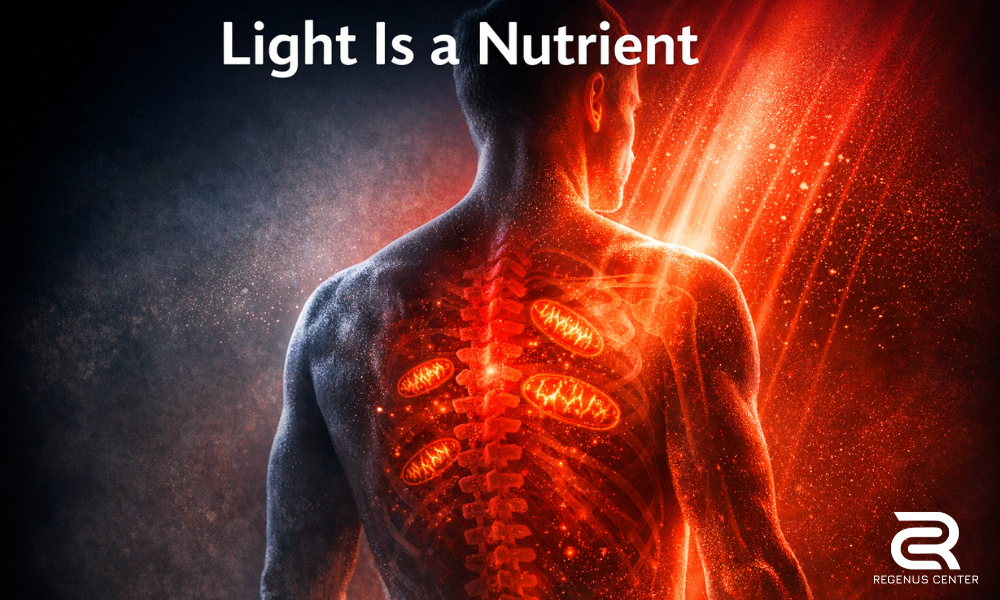
Malillumination and red light therapy are emerging as central topics in modern recovery and performance science because light is not optional biology. It is a nutrient, just like vitamins, minerals, oxygen, and water.
Most people don’t realize they’re light-deprived. They just feel tired, foggy, slower to recover — and assume that’s what adulthood feels like.
I didn’t reach this conclusion solely on the basis of theory. I came to it after decades of pushing my body, building businesses, and watching energy fade before strength ever did.
What Is Malillumination?
Malillumination refers to the absence or distortion of essential wavelengths of light required for normal human physiology. Malillumination is best understood as a light-based nutrient deficiency created by modern indoor living.
Modern life has dramatically changed our light environment:
-
We spend most of our time indoors
-
We receive too little natural sunlight
-
We’re overexposed to artificial blue light at night
-
We’re underexposed to red and near-infrared wavelengths altogether
The result isn’t immediate collapse — it’s slow biological energy debt.
You don’t feel broken.
You just feel underpowered.
Light Is a Nutrient, Not a Lifestyle Upgrade
The human body evolved under full-spectrum sunlight.
Different wavelengths act like different nutrients, each modulating specific processes:
-
Red & near-infrared light (600–1000 nm) → cellular energy & tissue repair
-
Blue light (daytime exposure) → alertness & circadian regulation
-
Balanced spectrum light → hormonal and metabolic signaling
Light deficiency and health: When these inputs are missing or mis-timed, the body doesn’t optimize—it compensates.
Over time, compensation becomes dysfunctional.
Mitochondria: Where Light Becomes Energy
At the cellular level, the impact of malillumination is unmistakable.
Your mitochondria — the energy engines inside every cell — are photo-responsive.
Red and near-infrared light stimulate cytochrome c oxidase, a key enzyme in the mitochondrial respiratory chain, and the structured water in the cell. With green light, it also stimulates the heme in the blood. This directly improves ATP (cellular energy) production.
When proper light is present:
-
ATP production increases
-
Oxidative stress decreases
-
Cellular repair accelerates
-
Recovery improves
When it’s missing:
-
Energy output drops
-
Inflammation rises
-
Healing slows
-
Fatigue becomes “normal.”
Hamblin, M.R. (2016). Mechanisms and applications of photobiomodulation. AIMS Biophysics.
Brain Function, Neurotransmitters, and the Endocrine System
Biological light deficiency.
Light doesn’t just power cells — it orchestrates systems.
Your brain and endocrine system rely on light signals to regulate:
-
Cortisol (stress response)
-
Melatonin (sleep and recovery)
-
Serotonin and dopamine (mood and motivation)
-
Thyroid hormone activity
-
Sex hormone balance
Chronic malillumination contributes to:
-
Poor sleep despite healthy habits
-
Brain fog and low motivation
-
Flattened daily energy
-
Increased stress sensitivity
📚 Cajochen et al. (2005). High sensitivity of human melatonin suppression to light. Journal of Clinical Endocrinology & Metabolism.
Inflammation, Metabolic Health, and Aging
Inflammation is often treated as the problem.
In reality, it’s frequently a signal of energy failure.
Without proper light stimulation:
-
Mitochondria shift into inefficient survival metabolism
-
Immune signaling becomes dysregulated
-
Insulin sensitivity declines
-
Recovery capacity collapses
This is why malillumination is increasingly associated with:
-
Metabolic dysfunction
-
Chronic pain and stiffness
-
Poor exercise recovery
-
Accelerated aging
📚 Reddy, G.K. (2004). Photobiological basis of low-intensity laser therapy. Journal of Clinical Laser Medicine & Surgery.
The Vitamin Deficiency Parallel That Makes It Click
We understand scurvy.
No vitamin C → collagen breakdown → tissue failure.
We understand rickets.
No vitamin D → calcium dysfunction → bone deformity.
Malillumination works the same way — just slower and more system-wide.
Lack of essential light wavelengths leads to:
-
Chronic fatigue
-
Poor recovery
-
Hormonal resistance
-
Inflammation without injury
-
Aging without resilience
Different nutrients.
Same biological law.
How Malillumination and Red Light Therapy Are Connected
Malillumination is the problem.
Red light therapy is one of the most effective modern solutions.
Through a process known as photobiomodulation, red and near-infrared light deliver the wavelengths modern life has removed — safely, precisely, and consistently.
This is why advanced recovery and wellness centers now prioritize red light therapy as a foundational energy intervention rather than a cosmetic add-on.
Hamblin, M.R. (2017). Photobiomodulation and mitochondrial function. Photomedicine and Laser Surgery.
You Can’t Hack Around Missing Light
You can eat clean.
You can train smart.
You can meditate daily.
But you cannot out-discipline missing biological inputs.
I’ve watched disciplined, successful people do everything “right” and still feel flat — not broken, just underpowered.
Light is not optional.
It’s not a trend.
It’s a requirement.
When light is restored:
-
Energy improves first
-
Recovery follows
-
Performance becomes sustainable
-
Aging slows at the cellular level
This isn’t about doing more.
It’s about restoring what modern life quietly removed.
Light is life. And you can’t afford to miss it.
— JAM
Founder-led recovery, performance, and energy education
FAQ: Malillumination and Red Light Therapy
What is malillumination in simple terms?
Malillumination is a chronic lack of biologically appropriate light exposure. It happens when your body doesn’t receive the wavelengths it needs to regulate energy, hormones, brain function, metabolism, and recovery.
How does red light therapy help with malillumination?
Red light therapy photobiomodulation restores essential red and near-infrared wavelengths that stimulate mitochondrial energy production, reduce inflammation, and support cellular repair.
Is red light therapy the same as sunlight?
No. Sunlight is full-spectrum and ideal when available. Red light therapy provides targeted therapeutic wavelengths that are difficult to obtain consistently indoors or during winter months.
Who benefits most from red light therapy?
People experiencing fatigue, poor recovery, joint pain, sleep issues, metabolic slowdown, chronic stress, or signs of accelerated aging often benefit the most.
Can nutrition and supplements replace light exposure?
No. Nutrition supports biology, but light directly powers cellular energy systems. You need both. One cannot replace the other.
Is malillumination a real medical condition?
Malillumination is not a formal diagnosis, but it describes a real biological problem supported by growing research in photobiomodulation, circadian biology, and mitochondrial science.