The Light Sauna Gap™
Why a Light Sauna Isn’t the Same as Advanced Red Light Therapy (Photobiomodulation)
By John Allen Mollenhauer (JAM), Founder of Regenus Center, Founder of Vitality Suites™ & Creator of the Performance Lifestyle®
There Is a Gap Most People Don’t Know Exists
I talk about it here.
Over the past decade, there has probably been one question I’ve answered more than any other at Regenus Center.
It usually starts with one of these statements:
“I already have a red light sauna.”
“My gym has red light.”
“My chiropractor has a light sauna.”
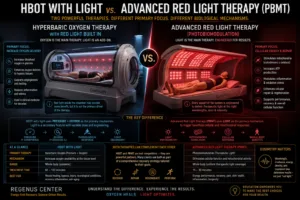
“My hyperbaric chamber has red light built into it.”
Then they experience one of our Advanced Whole-Body Photobiomodulation sessions.
Twenty minutes later, they usually smile, look at me, and say something like:
“That was nothing like what I expected.”
Or…
“I thought I’d already experienced red light therapy.”
They’re not alone.
In fact, I’ve heard some version of that conversation thousands of times.
That is exactly why I coined the phrase The Light Sauna Gap™.
What Is The Light Sauna Gap™?
The Light Sauna Gap™ is the difference between adding light to a sauna and engineering light as the primary biological therapy.
It’s the difference between using light as an accessory…
and using light as the treatment itself.
Understanding that difference helps consumers make decisions based on biology rather than marketing.
This article isn’t written to criticize infrared saunas or any particular manufacturer.
Quite the opposite.
I recommend infrared saunas to many of my clients.
They can be wonderful tools.
The problem begins when consumers are unintentionally led to believe that a light sauna, a red-light sauna, or red LEDs in another device are essentially the same as advanced whole-body photobiomodulation.
Scientifically…
they’re not.
My Journey Changed My Perspective
When we first opened Regenus Center, we offered infrared sauna therapy. People loved it. They relaxed. They perspired.
Many reported feeling refreshed afterward.
I do, and still do!
Some slept better.
Others felt less stiff.
Those are meaningful benefits.
But over time, something fascinating began happening. People who had regularly used infrared saunas would ask, “What’s that?” and point to our advanced rejuvenation and recovery chamber, and later experience one of our stand-alone whole-body photobiomodulation systems.
Nearly everyone noticed the difference immediately.
Not because one experience was “better.”
But because they were completely different.
That observation sent me down a years-long research path. The more I studied the scientific literature… the clearer it became. Heat therapy and photobiomodulation are not competing technologies.
They’re different biological interventions.
Each deserves to be understood on its own scientific merits.
The Marketplace Has Accidentally Created Confusion
Today, it seems almost every wellness technology advertises some version of:
- Red Light
- Infrared
- Near Infrared
- LED Therapy
- Red Light Sauna
- Light Sauna
- Photobiomodulation
The result?
Consumers naturally assume they’re all describing the same thing.
They’re not. The biology behind these therapies is fundamentally different. Unfortunately, marketing language often blurs those distinctions, and that’s why education matters.
Your Biology Doesn’t Care About Marketing
Photobiomodulation (PBM) is now one of the fastest-growing fields in regenerative medicine.
Over the past three decades, thousands of peer-reviewed publications have investigated its effects on:
- Cellular energy production
- Mitochondrial function
- ATP synthesis
- Inflammation modulation
- Tissue repair
- Muscle recovery
- Circulation
- Neurological health
- Pain reduction
- Skin rejuvenation
- Wound healing
- Cognitive performance
Unlike heat therapy, photobiomodulation works primarily through the interaction of specific wavelengths of red and near-infrared light with cellular chromophores. The best-studied target is cytochrome c oxidase, also known as Complex IV of the mitochondrial electron transport chain.
When therapeutic wavelengths reach this enzyme, research suggests they can influence:
- Electron transport efficiency
- ATP production
- Nitric oxide signaling
- Reactive oxygen species (ROS) signaling
- Cellular communication
- Gene expression involved in tissue repair
These responses have been demonstrated repeatedly in laboratory and clinical research.
But here’s the important point.
None of these effects occurs simply because a light appears red. The biological response depends on delivering the right wavelengths… at the right intensity… for the right amount of time… across enough tissue… to create a therapeutic dose.
Light Is More Than Color
One of the biggest misconceptions I encounter is this:
“If I can see red light…it must be red light therapy.”
Imagine saying: “If I hear someone playing piano… I’ve experienced a full orchestra.”
Technically, both involve music. Practically, they’re completely different experiences.
The same principle applies here.
Successful photobiomodulation depends upon carefully engineered variables, including:
- Wavelength
- Irradiance (power density)
- Fluence (energy delivered)
- Exposure time
- Distance from the body
- Beam angle
- Uniformity of exposure
- Spectral accuracy
- Thermal management
- Full-body treatment geometry
Without these factors, the biological response changes dramatically.
This is one of the reasons why two products that both appear to emit “red light” can produce entirely different therapeutic outcomes.
Why an Infrared Light Sauna Is Not Advanced Red Light Therapy
This distinction is incredibly important.
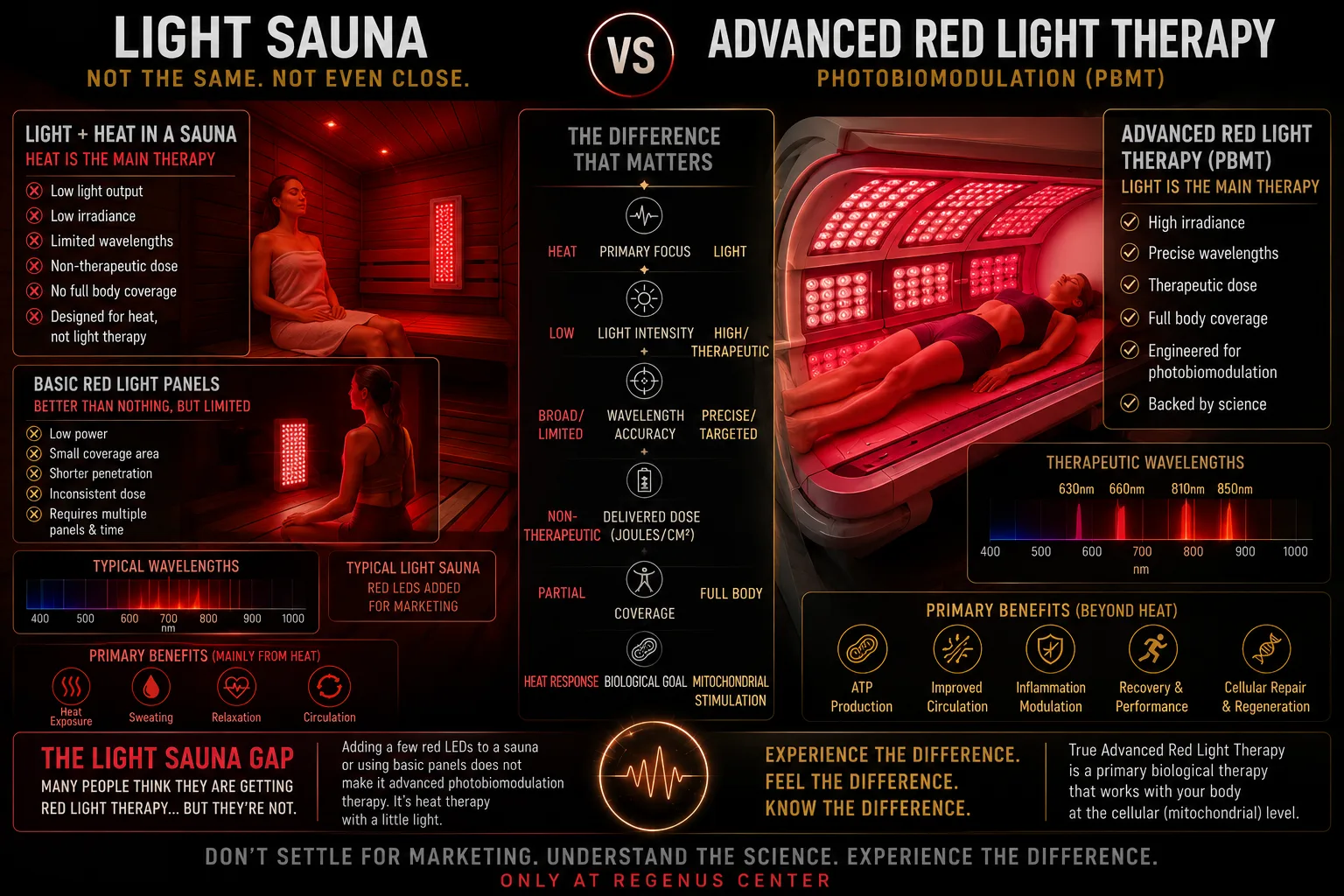
An infrared light sauna is primarily engineered to produce heat.
Its primary biological mechanisms include:
- Elevated tissue temperature
- Increased circulation
- Sweating
- Heat shock protein activation
- Cardiovascular conditioning
- Relaxation
Those benefits are well supported by scientific literature. In fact, regular sauna bathing has been associated with improvements in cardiovascular health and vascular function, as well as reductions in all-cause mortality, in several observational studies.
I still recommend infrared sauna therapy, as part of the BioVitality Protocol™
But the reason I recommend it has nothing to do with photobiomodulation. It is fundamentally a heat therapy.
Advanced whole-body photobiomodulation is fundamentally a light therapy.
Light Sauna is beneficial, don’t get me wrong, but more about marketing than regeneration.
Those are different biological interventions. Adding red LEDs to a sauna doesn’t suddenly transform the sauna into a medical-grade photobiomodulation system.
It simply adds light to a heat therapy environment.
That distinction…
is the Light Sauna Gap™.
Heat Changes the Biological Environment
Another important consideration is something rarely discussed. Most published photobiomodulation research is performed under carefully controlled treatment conditions.
Inside a heated sauna, however:
- Core temperature rises.
- Blood flow changes.
- Sweating increases.
- Humidity often increases.
- Skin temperature rises significantly.
Those environmental changes may alter how light interacts with tissue compared to a dedicated photobiomodulation treatment performed under standardized conditions.
That doesn’t necessarily make the sauna less valuable.
It simply means we should avoid assuming the biology is identical.
Because it isn’t.
Why Basic Red Light Panels Are Different Too
Another question I hear frequently is:
“Would I be better off buying a basic red light panel?”
In many cases…
yes.
A quality stand-alone red light panel specifically designed for photobiomodulation may provide a more authentic PBM experience than simply placing decorative LEDs inside a sauna.
However, there is still another gap.
Most consumer panels are designed to treat one body area at a time.
Advanced whole-body photobiomodulation systems are engineered to provide therapeutic wavelengths across nearly the entire body simultaneously with carefully controlled optical geometry, irradiance, treatment consistency, and dosing.
That’s why we developed BioVitality PRO™—because when it comes to photobiomodulation, treating your entire body is fundamentally different from treating one area at a time.
In other words, there are really three different categories:
- Heat therapy (infrared sauna)
- Basic photobiomodulation (consumer panels)
- Advanced whole-body photobiomodulation
Each serves a different purpose.
None should be confused with another.
About the Author
John Allen Mollenhauer (JAM) is the Founder of Regenus Center, Founder of Vitality Suites™, and Creator of the Performance Lifestyle®. Through decades of research, coaching, and tens of thousands of client recovery sessions, he has become a leading advocate for an Energy-First approach to health, recovery, and high-capacity living. His primary work focuses on helping individuals understand the biology behind today’s most advanced wellness technologies so they can make informed decisions that expand energy, capacity, and quality of life.