
Why Summer Is the Perfect Time to Build Your Cellular Energy—Not Take a Break from It
Why longer days and more sunshine don’t replace the need to regenerate ATP.
By John Allen Mollenhauer (JAM)
Every June, July, and August, I hear some version of the same question.
“JAM, the sun’s finally out. Should I take a break from photobiomodulation until the fall?”
It’s a fair question.
After months of gray skies and short winter days, summer feels like nature has finally come to the rescue. And to a degree, it has. I’m the first person to encourage our clients to spend more time outside, get morning sunlight, take a walk instead of another meeting, and reconnect with the natural rhythms our biology evolved under.
Natural sunlight is one of the greatest gifts we have.
But here’s what I’ve learned after facilitating more than 56,000 rejuvenation sessions at Regenus Center.
Summer is one of the best times to build your cellular energy—not one of the best times to stop supporting it.
That’s because your cellular energy doesn’t take a summer vacation.
Your mitochondria are still producing ATP every second of every day. Every heartbeat, every thought, every muscle contraction, every immune response, and every repair process depends on healthy mitochondria producing enough energy to meet the demands you place on your body.
The season changes. Your biology doesn’t.
One of the biggest misunderstandings I see is the belief that feeling better means your cells have fully recovered. Feeling better is wonderful, but it’s not the same as restoring the biological capacity to consistently produce energy.
Those are two very different things.
I often tell people that the goal isn’t simply to have more energy today. The real goal is to build a body that naturally creates more energy tomorrow, next month, and ten years from now.
That’s what cellular energy is really about.
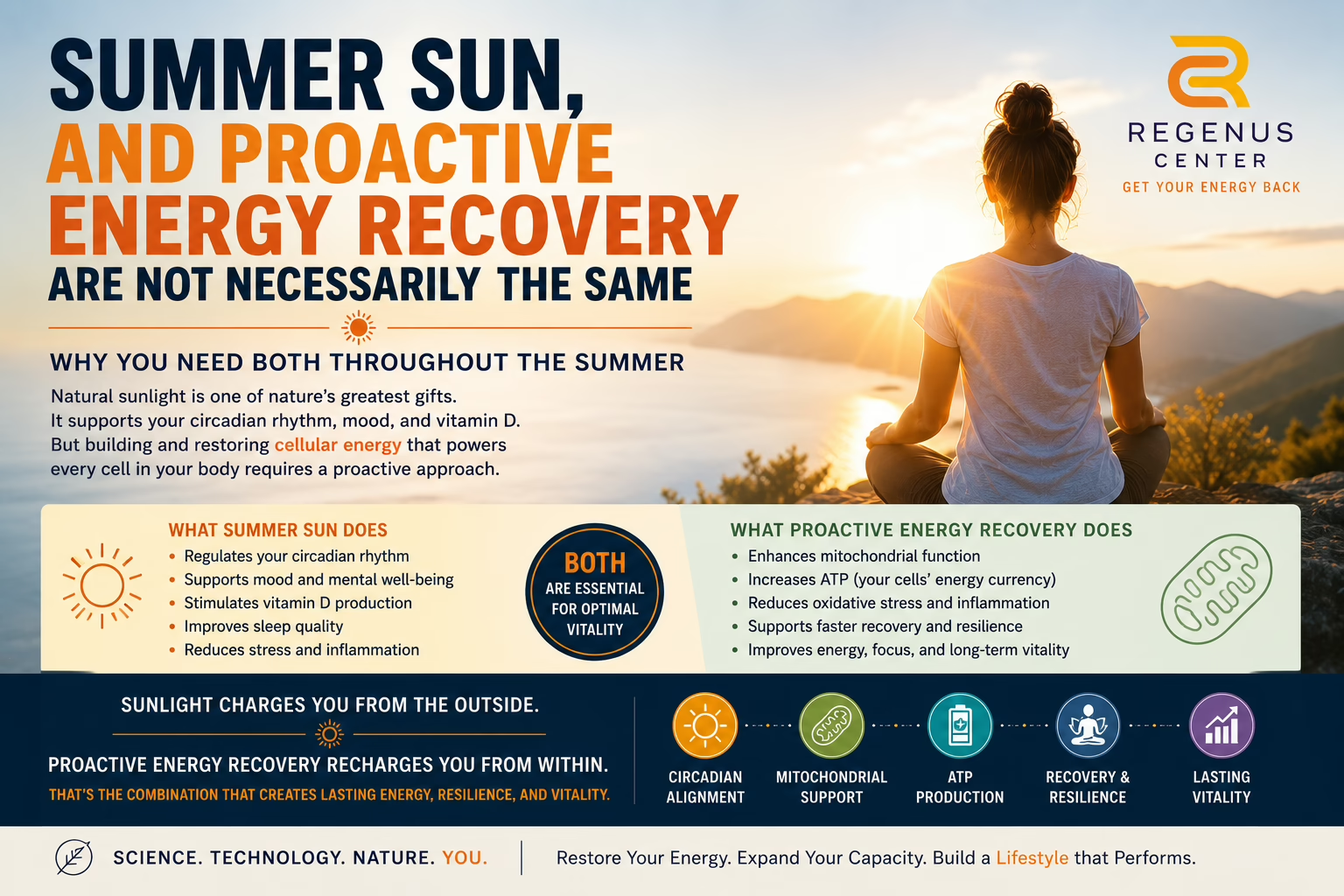
Natural sunlight absolutely helps. It supports circadian rhythms, hormone regulation, mood, sleep quality, nitric oxide biology, and countless processes that contribute to healthier mitochondria. Modern research continues to demonstrate the importance of natural light exposure for human physiology.
But most of us don’t live the way our biology was designed to live.
We spend long hours indoors under artificial lighting. We work at computers. We commute in cars. We manage businesses, raise families, deal with financial pressures, answer emails late into the evening, and often sleep less than we should.
In other words, modern life continues to place extraordinary demands on our cellular energy, even during the brightest months of the year.
That’s one reason I don’t look at sunlight and photobiomodulation as competitors.
I see them as teammates.
One is nature’s original design.
The other is a therapeutic technology that allows us to deliver precise wavelengths of red and near-infrared light, which have been shown to interact with cytochrome c oxidase, the hemoglobin in the blood, and the water surrounding the cell. This interaction supports mitochondrial function, ATP production, healthy cellular signaling, and tissue repair. It’s the primary supplemental way to help the body do what it was designed to do.
At Regenus Center, we don’t use photobiomodulation because people are broken.
We use it because today’s performance culture asks far more of our biology than nature ever intended.
Many people spend years accumulating what I call Personal Energy Debt™—the biological consequences of chronically spending more energy than they consistently regenerate. Poor sleep, chronic stress, processed foods, circadian disruption, and inadequate recovery don’t disappear simply because the calendar turns to June.
If anything, summer gives us a tremendous opportunity to begin paying that debt back.
The longer days make it easier to walk outside before work. Fresh, nutrient-rich foods are abundant. Many people naturally become more active, sleep a little better, and spend more time in nature.
Why wouldn’t you combine those advantages with therapies that further support your cellular energy?
That’s exactly what I do. I’ve never viewed regeneration as something you do only when you’re exhausted. Regeneration is how you build the capacity to live the life you want before exhaustion ever arrives.
That’s one of the foundational ideas behind the Performance Lifestyle® philosophy we teach.
The objective isn’t simply to recover.
The objective is to continually expand your capacity. To think more clearly. To recover more quickly. To remain healthier as you age.
To show up with greater resilience for the people who depend on you.
All of those outcomes begin with healthier cellular energy.
That’s why I don’t recommend taking the summer off from taking care of yourself, which starts with proactive energy recovery.
I recommend using summer to create momentum you’ll carry into the fall and winter.
Get outside.
Enjoy the sunshine.
Take the family for a walk after dinner.
Eat a whole-food, nutrient-rich meal on the patio.
Wake up with the sun whenever possible.
Then continue doing the things that intentionally support your mitochondria and ATP production. Your body doesn’t know it’s June. It only knows the signals you provide each day.
Movement. Nutrition. Sleep. Light. Recovery.
Those signals determine the quality of your cellular energy, and ultimately, the quality of your life. At Regenus Center, that’s what we’re really helping people restore. Not simply more energy for today.
The biological capacity to create energy for years to come.
Scientific References
Hamblin MR. Mechanisms and applications of the anti-inflammatory effects of photobiomodulation. AIMS Biophysics. 2017;4(3):337–361.
de Freitas LF, Hamblin MR. Proposed mechanisms of photobiomodulation. IEEE Journal of Selected Topics in Quantum Electronics. 2016;22(3):348–364.
Karu TI. Mitochondrial signaling in mammalian cells activated by red and near-infrared radiation. Photochemistry and Photobiology. 2008;84(5):1091–1099.
Wallace DC. Mitochondria and the biology of disease. Nature. 2012;489:354–362.
Reiter RJ, Rosales-Corral SA, Tan DX, et al. Melatonin, circadian rhythms, and mitochondrial function. Cellular and Molecular Life Sciences. 2018.
Panda S. The Circadian Code. Rodale Books. 2018.