

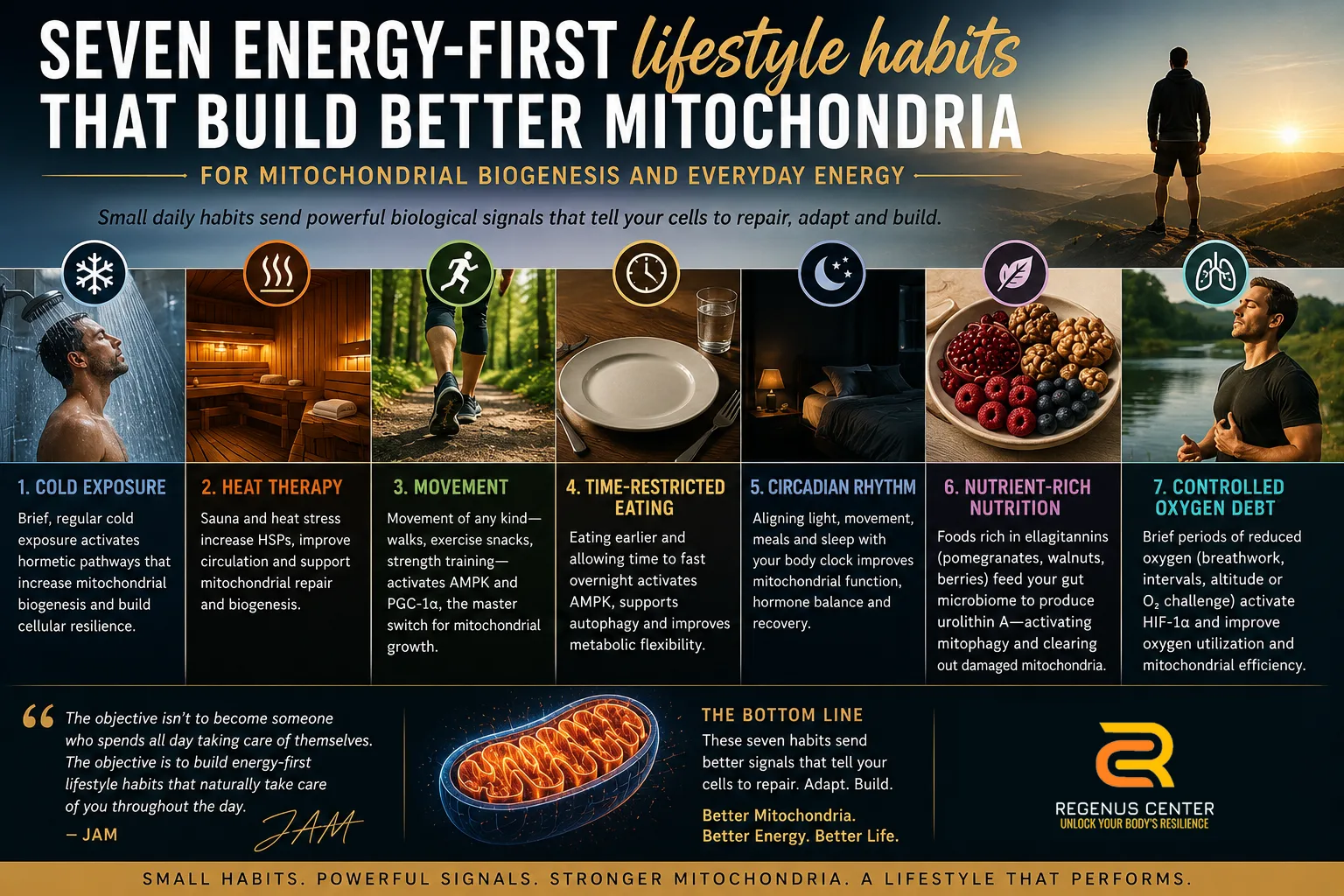
Seven Energy-First lifestyle habits That Naturally Support Mitochondrial Biogenesis
How Daily Micro Habits Improve Mitochondrial Health, Cellular Energy, and Help You Build Better Mitochondria Naturally
Part 1
By John Allen Mollenhauer (JAM)
“The objective isn’t to become someone who spends all day taking care of themselves. The objective is to build energy-first lifestyle habits that naturally take care of you throughout the day.”
If you’ve been researching ways to improve your energy, reduce fatigue, or age more successfully, you’ve probably encountered the term mitochondrial biogenesis.
Although it sounds highly technical, the concept is surprisingly simple—and incredibly important.
Mitochondrial biogenesis is your body’s natural process of building new, healthier, and more efficient mitochondria. These tiny structures are often called the “powerhouses” of the cell because they convert the food you eat and the oxygen you breathe into ATP, the energy currency that powers virtually every function in your body.
Whether you’re thinking clearly at work, recovering from exercise, playing with your children, or simply getting through a busy day, you’re relying on healthy mitochondria to produce the energy your body needs.
The exciting news is that mitochondrial biogenesis isn’t controlled by a miracle supplement or one perfect workout.
It’s influenced by your daily habits.
Research continues to show that simple lifestyle choices—moving your body, sleeping well, eating nutrient-rich foods, managing meal timing, and exposing yourself to appropriate physical challenges—can naturally support mitochondrial biogenesis, improve mitochondrial health, and enhance cellular energy over time.
In other words, your body is constantly listening to the signals you send it.
The question is:
Are your daily habits encouraging your cells to become stronger—or simply asking them to survive another day?
What Is Mitochondrial Biogenesis?
Your body contains trillions of cells.
Inside most of those cells are hundreds—or even thousands—of mitochondria.
These remarkable organelles do much more than produce energy.
Healthy mitochondria help regulate:
- ATP production
- Cellular energy
- Muscle function
- Brain performance
- Recovery
- Metabolic health
- Healthy aging
- Cellular resilience
Like every part of your body, mitochondria age.
They become damaged.
Some become less efficient.
Others need to be removed altogether.
Fortunately, your body has developed an elegant quality-control system.
Scientists call it mitochondrial quality control.
This system includes several interconnected processes, including mitochondrial biogenesis, mitophagy, mitochondrial fusion, and mitochondrial fission.
Think of it like maintaining a fleet of vehicles.
Older engines are repaired or retired.
New engines are built.
The entire fleet becomes stronger and more efficient.
That’s exactly what mitochondrial biogenesis helps accomplish.
It ensures your body continues replacing older, less efficient mitochondria with healthier ones capable of producing more energy.
While genetics certainly influence mitochondrial health, lifestyle plays an enormous role in determining how effectively these natural renewal processes occur throughout your life.
Better Habits Build Better Biology
One of the biggest misconceptions in health is that improving your biology requires adding more hours to your day.
For most people, that’s simply unrealistic.
You already have a career.
A family.
Responsibilities.
Appointments.
Commutes.
Deadlines.
You don’t need another two-hour morning routine.
You need habits, like advanced red light therapy/photobiomodulation, that fit naturally into the life you’re already living.
That’s why I talk so much about energy-first lifestyle habits.
These aren’t dramatic life overhauls.
They’re small, repeatable behaviors that quietly support your biology throughout the day.
A cold shower.
A walk during lunch.
An earlier dinner.
A handful of walnuts with breakfast.
A few intentional breaths between meetings.
Better sleep.
Individually, these habits may seem insignificant.
Together, they create an environment that naturally supports mitochondrial biogenesis, healthier mitochondrial function, and better cellular energy.
Small habits.
Repeated consistently.
Become extraordinary biology.
1. Move Every Day to Support Mitochondrial Biogenesis
If there were a single lifestyle habit with the strongest scientific support for mitochondrial biogenesis, it would probably be regular physical activity.
Every time you move, your muscles require more ATP.
Your cells immediately recognize the increased energy demand and activate signaling pathways—including PGC-1α—that encourage mitochondrial biogenesis.
Over time, this helps your body:
- Build healthier mitochondria
- Improve mitochondrial function
- Increase cellular energy production
- Improve metabolic flexibility
- Support healthy aging
The encouraging news is that you don’t have to become a marathon runner.
Walking.
Resistance training.
Cycling.
Swimming.
Bodyweight exercises.
Even several short “exercise snacks” spread throughout the day can provide meaningful benefits.
Research increasingly shows that interrupting prolonged sitting with brief periods of movement improves metabolic health while supporting the same biological systems involved in mitochondrial health.
Movement isn’t simply burning calories.
It’s teaching your body to become better at producing energy.
Lifestyle Habit
Look for opportunities to move throughout the day.
Walk during phone calls.
Take the stairs.
Perform two or three minutes of bodyweight exercises between meetings.
The best exercise program is often the one you’ll actually continue doing.
2. Use Heat and Cold to Naturally Support Mitochondrial Health
Your body was designed to adapt.
Small, controlled physical challenges encourage your cells to become stronger and more resilient.
Scientists refer to this principle as hormesis.
Two of the simplest examples are heat and cold.
Regular sauna use stimulates heat shock proteins, improves circulation, and supports recovery while activating pathways associated with mitochondrial health.
Likewise, brief cold exposure activates adaptive stress responses, increases norepinephrine, and may help support mitochondrial biogenesis through several overlapping cellular pathways.
The key isn’t extreme discomfort.
The goal is an appropriate challenge followed by recovery.
You don’t need an ice bath every morning.
Finishing your shower with 30 to 60 seconds of cool or cold water is an easy place to start.
Likewise, a few sauna sessions each week can become part of a long-term recovery routine.
Together, heat and cold remind your biology that it needs to keep adapting.
And adaptation is exactly what healthy mitochondria do best.
Lifestyle Habit
Finish your morning shower with cool or cold water and consider regular sauna sessions as part of your weekly recovery routine.
3. Respect Your Circadian Rhythm for Better Mitochondrial Function
Many people think sleep is simply about resting.
In reality, sleep is one of the most important periods for recovery, repair, and maintaining healthy mitochondrial function.
Your mitochondria operate according to your body’s internal clock.
When your circadian rhythm becomes disrupted by irregular sleep schedules, late-night eating, excessive artificial light, or chronic sleep deprivation, mitochondrial efficiency begins to suffer.
Supporting mitochondrial biogenesis isn’t only about what you do during the day.
It’s also about allowing your body sufficient time to recover at night.
One of the simplest ways to improve circadian health is creating what I call a buffer between work and sleep.
Turn down the lights.
Reduce stimulating activities.
Avoid unnecessary screen time.
Allow your nervous system to transition from performance mode into recovery mode.
Healthy sleep helps regulate many of the genes involved in mitochondrial biogenesis, making it one of the simplest—and most overlooked—ways to support long-term mitochondrial health.
Lifestyle Habit
Protect your sleep with a consistent bedtime, morning sunlight, and an intentional evening wind-down routine.
Scientific References
- Hood DA, et al. Maintenance of Skeletal Muscle Mitochondria in Health, Exercise, and Aging. Annu Rev Physiol. 2019.
- Egan B, Zierath JR. Exercise Metabolism and the Molecular Regulation of Skeletal Muscle Adaptation. Cell Metab. 2013.
- Laukkanen JA, et al. Association Between Sauna Bathing and Cardiovascular Health. JAMA Intern Med. 2015.
- Longo VD, Panda S. Fasting, Circadian Rhythms, and Time-Restricted Feeding. Cell Metab. 2016.
- Mattson MP, et al. Impact of Intermittent Fasting on Health and Disease Processes. N Engl J Med. 2017.
- Ryu D, et al. Urolithin A Induces Mitophagy and Improves Muscle Function. Nat Med. 2016.
- Andreux PA, et al. Urolithin A and Improved Mitochondrial Health in Humans. Nat Metab. 2019.
- Navarrete-Opazo A, Mitchell GS. Therapeutic Potential of Intermittent Hypoxia. Am J Physiol. 2014.
- Burtscher J, et al. Intermittent Hypoxia Training: Mechanisms and Clinical Applications. Front Physiol. 2021.
- Booth FW, Roberts CK, Laye MJ. Lack of Exercise Is a Major Cause of Chronic Diseases. Compr Physiol. 2012.