
Why a Red Light Therapy Panel Is Not the Same as a Full-Body Photobiomodulation Bed
What You Need to Know About Coverage, Positioning, Dose, and the Recovery Experience
By John Allen Mollenhauer (JAM)
Founder, Regenus Center™
Red light therapy has been everywhere for the past 5 years.
You can purchase a panel for your home, stand in front of one at a gym, or visit a wellness business that has added a few lights and now advertises “red light therapy.”
Technically, it may.
But that does not mean you are receiving the same treatment—or the same value—you would receive from advanced, commercial-grade, full-body photobiomodulation equipment.
At Regenus Center™, we are increasingly seeing businesses enter this market with relatively inexpensive light panels. Many charge retail-service prices without investing in advanced rejuvenation and recovery systems that expose substantially more of the body, at the right dose, power density, fluence, and irradiance, in a controlled, comfortable treatment environment.
Customers usually do not know the difference.
They see red light. They hear similar claims. They reasonably assume that one red light therapy session is much like another.
Then they experience the real thing.
And they immediately understand why the equipment, the treatment environment, and the way the light is delivered matter.
Red Light Is Not the Treatment—It Is One Part of the Treatment
Photobiomodulation, or PBM, uses specific wavelengths of red and near-infrared light to influence biological processes.
Research suggests that appropriately delivered light may interact with mitochondrial and cellular signaling pathways, including cytochrome c oxidase activity, nitric oxide signaling, reactive oxygen species, ATP production, inflammation, and tissue-repair responses. The exact mechanisms are still being investigated, and they may vary by tissue, wavelength, and treatment parameters. Hamblin, 2017; Dompe et al., 2020
But the presence of red and near-infrared LEDs does not, by itself, define an effective treatment.
Photobiomodulation depends on multiple interacting variables:
- Wavelengths
- Irradiance, or power delivered per unit of area
- Total energy delivered
- Treatment time
- Distance from the light
- Angle of exposure
- Area of the body treated
- Tissue depth and optical properties
- Treatment frequency
- Individual biological response
Researchers have repeatedly warned that PBM outcomes cannot be interpreted from wavelength or advertised power alone. The complete combination of treatment parameters matters. Zecha et al., 2016; Mosca et al., 2019
In other words:
Seeing red light does not tell you how much useful light is reaching which tissues, or how consistently it is being delivered.
The First Major Difference: Body Coverage
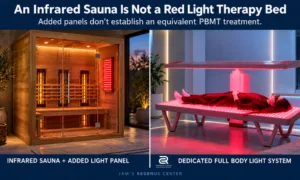
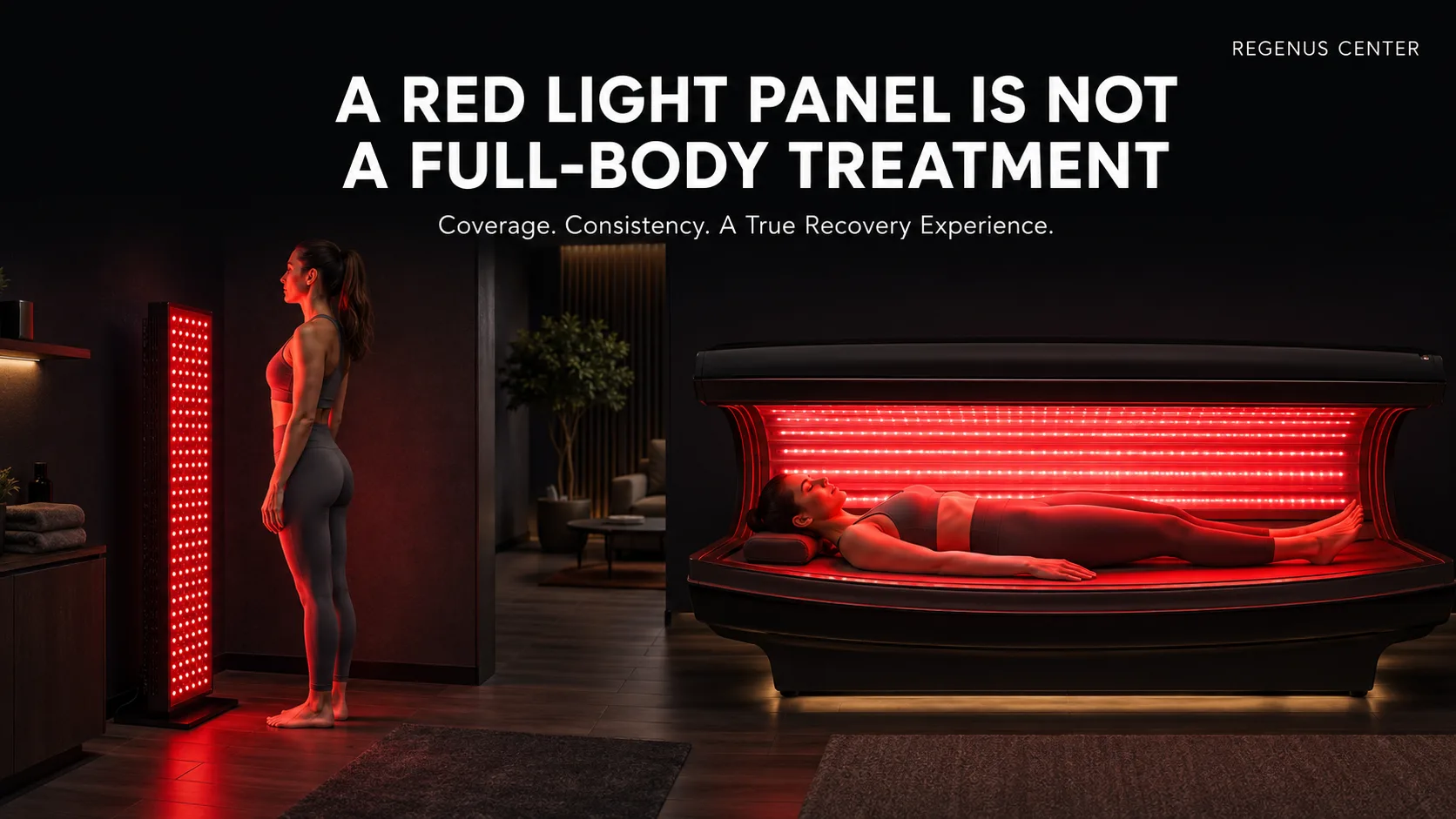
A panel primarily exposes the surface facing it.
If you stand in front of it, the front of your body receives the greatest exposure. The sides, back, and areas hidden by the contours of the body receive less direct light unless you reposition yourself repeatedly.
That does not make a good panel useless. Panels can be appropriate for home use, localized applications, or people willing to carefully manage distance, time, positioning, and body rotation.
But standing in front of a panel is not automatically a full-body treatment.
A full-body photobiomodulation bed or a surrounding light system is designed to expose a much larger percentage of the body simultaneously. Instead of treating an entire three-dimensional person with a light source positioned mainly on one side, the equipment surrounds—or more comprehensively covers—the body.
This matters because PBM is delivered to the tissue that is actually irradiated.
In one randomized, triple-blind study, PBM improved muscle performance and recovery when applied directly to the exercised muscles. Irradiating a different, nonlocal muscle group did not produce the same results. Machado et al., 2020
That does not prove that every photobiomodulation benefit must be completely local. Researchers are investigating possible systemic effects. But it does reinforce an important practical point:
You cannot assume that illuminating one part of the body is equivalent to directly exposing the rest of it.
For broader exposure, coverage matters.
The Second Difference: Distance and Dose Consistency
The amount of light reaching the body varies with distance, angle, device optics, and how light spreads across the treatment area.
When someone stands in front of a panel, not every part of their body is necessarily at the same distance from the light. The chest may be closer than the lower legs. The shoulders may receive light at a different angle than the torso sides. Small movements can continually alter the exposure.
The manufacturer may report impressive irradiance at a single measured point and at a specified distance. That number does not necessarily reflect the dose delivered uniformly throughout the body.
And more power is not automatically better.
Photobiomodulation demonstrates a biphasic dose response: too little light may not produce the desired response, while excessive irradiance, energy, or treatment time may reduce or even inhibit the intended effect. Huang et al., 2009; Huang et al., 2011
This is one of the most misunderstood ideas in the red light marketplace.
An effective session is not simply the brightest device used for the longest time. It is an appropriately designed dose delivered to the intended treatment area.
A well-designed full-body system can make positioning and distance more repeatable. That does not guarantee that every bed is superior to every panel, but it gives advanced equipment a major design advantage when the objective is consistent, broad-body exposure.
The Third Difference: You Can Actually Remain Still
There is currently no strong scientific evidence that photobiomodulation only works when a person is physiologically at rest. PBM has been successfully studied before exercise, after exercise, and in combination with training. Leal-Junior et al., 2019; Vanin et al., 2018
So we are not claiming that cellular photobiomodulation becomes ineffective merely because someone is standing.
However, remaining still and properly positioned can make a substantial practical difference in the treatment received.
If you are shifting your weight, turning around, adjusting your body, changing your distance from the panel, or trying to expose multiple sides sequentially, the delivery becomes less consistent. Some areas receive more exposure, some receive less, and some may spend much of the session outside the most useful treatment field.
In a full-body bed, you can lie down, stay in a stable position, and let the equipment deliver light across a much larger area without continually managing the treatment yourself.
That is the scientifically defensible distinction:
Rest is not a proven prerequisite for PBM to work. Stillness, consistent positioning, greater exposure, and adherence to the intended protocol can help you receive the treatment as designed.
But there is another reason we intentionally make the session restful at Regenus Center.
Most people coming to us do not merely need another biohacking task squeezed into an already overloaded day. They need a genuine recovery interval.
Lying down in a controlled environment allows the session to become more than exposure to light. It creates a protected period in which you are not working, exercising, scrolling, rushing, or spending more energy.
You are finally allowing recovery to become the priority.
The Fourth Difference: A Device Versus a Recovery Experience
A home panel can be a useful tool.
But owning a tool and consistently using it under the right conditions are two different things.
At home, people frequently shorten sessions, stand at inconsistent distances, wear clothing over intended treatment areas, check their phones, skip body positions, or stop using the equipment altogether.
A professional session removes much of that friction.
You arrive. The treatment is prepared. The equipment is ready. The environment supports stillness. Your positioning and treatment time can be kept more consistent.
This matters because the real-world value of any recovery technology depends not only on what it can theoretically do, but also on whether the person uses it properly and consistently.
What Does the Research Say About Full-Body Systems?
Research specifically evaluating whole-body light beds is newer and much smaller than the broader PBM literature.
A randomized, crossover study in trained men found that whole-body light-bed PBM affected certain post-exercise measures, though not all markers improved significantly. Rossato et al., 2020
Randomized studies of whole-body PBM in people with fibromyalgia have reported improvements in outcomes such as pain, quality of life, and psychological factors, although more independent research and larger trials are needed. Serrano-Muñoz et al., 2023; Collazo-Muñoz et al., 2024
A 2025 systematic review of whole-body PBM for exercise performance and recovery found promising results but also emphasized the small number of studies and substantial differences among treatment protocols. Systematic review of whole-body PBM
The honest conclusion is not that every whole-body bed has been proven superior to every panel. There are not enough direct, independent, head-to-head trials to make that claim.
The conclusion is this:
The device configuration determines how the light is delivered. A panel and a full-body system should not be marketed as providing identical treatment simply because both contain red and near-infrared LEDs.
Commercial-Grade Should Mean More Than a Higher Price
A business should not be able to place an ordinary consumer panel in a room, call it a professional service, and assume the customer is receiving premium value.
Before paying for red light therapy, ask:
- How much of my body is directly exposed at once?
- Which wavelengths does the equipment use?
- What irradiance reaches the body at the actual treatment distance?
- Is the irradiance reasonably uniform across the treatment area?
- What dose is being delivered, and how was the protocol selected?
- Will I need to rotate or reposition during the session?
- Is the system designed for repeated commercial use?
- What makes this treatment meaningfully different from using a home panel?
- Are the benefits being described accurately, without guarantees or exaggerated medical claims?
“Commercial grade” should describe the engineering, treatment coverage, repeatability, durability, protocol, and client experience—not merely the price charged for the session.
Why Regenus Center Invested in Advanced Equipment
At Regenus Center, we could have taken the easier route.
We could have purchased inexpensive panels, placed them against a wall, and advertised red light therapy.
Instead, we invested in advanced rejuvenation and recovery equipment because we wanted to deliver an experience that people could not easily reproduce by standing in front of a small panel at home.
We wanted people to lie down.
We wanted them to stop spending energy for a few minutes.
We wanted broader, more consistent exposure and a treatment environment deliberately designed around recovery.
Most importantly, we wanted the service to provide genuine value.
Because the category name is not the treatment.
The red glow is not the treatment.
And being able to say, “We offer red light therapy,” does not mean every facility is offering the same thing.
A panel can be useful.
A well-designed full-body photobiomodulation system can provide a fundamentally different level of coverage, consistency, comfort, and recovery experience.
Once you experience that difference, it becomes very difficult not to see it.
Don’t Just See the Light. Experience the Difference.
Discover advanced, full-body photobiomodulation in a recovery environment designed to help you remain still, receive broader exposure, and put your energy first.
Schedule Your Advanced Red Light Therapy Session at Regenus Center™