
How to Increase Mitochondrial Function Naturally (And Why It Changes Everything About Your Energy)
You Don’t “Have” Energy—You Produce It
If you’re trying to understand how to increase mitochondrial function naturally, you’ve got to start with a shift that, honestly, most people have never been taught:
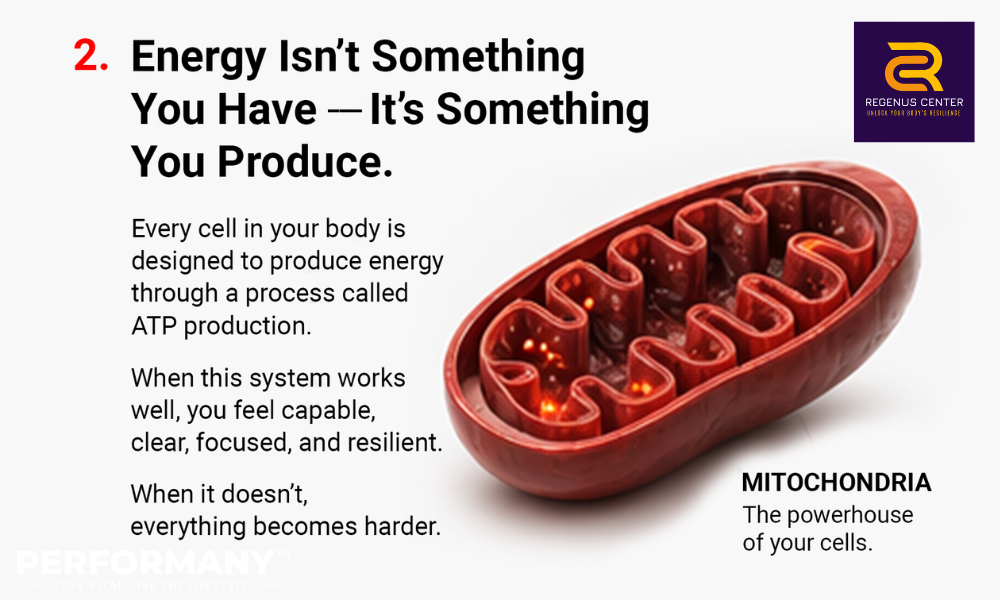
Energy isn’t something you have.
It’s something your body produces—moment to moment.
That might sound simple, but it changes everything.
Because if that production system isn’t working the way it should…
You don’t just feel a little tired.
You feel off. Slower. Less sharp.
Like a scaled-down version of yourself.
Most people don’t connect that feeling to what’s actually going on under the hood.
The Real Source of Energy: Your Mitochondria
Inside nearly every cell in your body are mitochondria—tiny, highly specialized structures responsible for producing ATP (adenosine triphosphate).
ATP isn’t just “energy” in a vague sense.
It’s the actual currency of biological function.
Everything you do depends on it:
- Brain function
- Muscle contraction
- Cellular repair
- Hormonal signaling
All of it.
And here’s something most people have never heard…
👉 Your body doesn’t store meaningful amounts of ATP.
👉 It has to produce it continuously, all day long.
In fact, your body turns over its entire ATP supply daily—roughly equivalent to your body weight.
(Berg JM et al., Biochemistry, 8th Edition)
Think about that for a second.
You’re not running on stored energy.
You’re running on production capacity.
Why Most People Feel Low Energy Today
When someone says:
“I’m just tired…”
It sounds normal. Almost expected.
But it’s not random.
Fatigue, brain fog, inflammation, slow recovery—
Those are signals.
Your system is telling you something.
You’re not producing enough energy to meet demand.
That’s what I call:
⚠️ Energy Debt
And right now, it’s everywhere.
Especially in today’s fast-paced performance culture.
You’ve got:
- Chronic stress
- Poor sleep cycles
- Nutrient gaps
- Constant stimulation
All stacking up.
All quietly impairing mitochondrial efficiency.
And over time, that’s not just a feeling—it becomes measurable.
Research has linked mitochondrial dysfunction to:
- Chronic fatigue syndromes
- Neurodegenerative diseases
- Metabolic disorders
- Accelerated aging
(Nunnari & Suomalainen, Cell, 2012)
(Wallace DC, Physiological Reviews, 2013)
So when people say:
“I don’t feel like myself…”
They’re closer to the truth than they realize.
👉 It’s a breakdown in energy production at the cellular level
What It Actually Means to Increase Mitochondrial Function Naturally
So if energy is produced—not possessed—
Then the real question becomes:
How do you increase mitochondrial function naturally?
At the biological level, you’re really talking about improving:
- The efficiency of the electron transport chain
- Oxygen utilization
- Cellular respiration
- ATP output
And right at the center of all of this is an enzyme most people have never heard of:
Cytochrome c Oxidase
This component of the mitochondrial respiratory chain plays a key role in converting oxygen into usable energy.
When that process slows down:
- Energy drops
- Oxidative stress increases
- Recovery takes longer
When will it improve?
You feel it.
Not in theory—in your day.
One of the Most Overlooked Tools: Photobiomodulation
This is where things start to connect in a real way.
Photobiomodulation (PBM)—red and near-infrared light therapy—has been shown to directly influence mitochondrial function.
Specifically, it interacts with cytochrome c oxidase in a way that:
- Enhances electron transport
- Improves ATP production
- Reduces oxidative stress
- Helps release nitric oxide, improving oxygen availability
(Karu TI, Journal of Photochemistry & Photobiology B, 1999)
(Hamblin MR, Photobiomodulation, Photomedicine, and Laser Surgery, 2017)
That last part—nitric oxide—is important.
Because when it’s bound in the cell, it can actually inhibit respiration.
When light helps release it, oxygen flows more freely.
And that’s when energy production picks up.
In plain terms:
👉 Your cells start doing their job better.
Why This Matters (And Why I Care About It)
I’ve seen this play out in real life—over and over again—across 50,000+ sessions at Regenus Center.
People don’t come in talking about mitochondria.
They come in saying:
- “I’m exhausted.”
- “I can’t think clearly.”
- “I feel inflamed.”
- “I don’t bounce back like I used to”
They just know something’s off.
And when their energy production improves?
You see it.
- Their clarity comes back
- Their recovery speeds up
- Their body starts responding again
Not because we stimulated them…
But because we restored something fundamental.
The Trap Most People Stay In
Here’s where most people get stuck.
They try to fix low energy with:
- Caffeine
- Sugar
- Motivation
- Pushing harder
And for a little while… it works.
Until it doesn’t.
Because that’s not energy production.
That’s borrowing energy.
And eventually, the bill comes due.
Two Ways to Start Rebuilding Your Energy
Once you understand how to increase mitochondrial function naturally, the path gets clearer.
You don’t need to guess anymore.
⚡ 1. Experience It at Regenus Center
This is what we do every day.
At Regenus Center, we use advanced photobiomodulation and recovery technologies to help restore cellular energy—at the level it actually matters.
This isn’t about hype.
It’s about helping your body do what it’s designed to do.
👉 Book your session and experience the BioVitality Protocol.™ Call us at 862-295-1620.
🏠 2. Build Your Own Vitality System
If you want this working for you consistently, or you can’t always make it in—
You can build your own Vitality Suite at home or in your office, starting with the BioVitality PRO™.
Same core principle.
Now in your environment.
👉 Start building your Vitality Suite
Final Thought
You don’t need more stimulants.
You don’t need more hacks.
You need your system working the way it was designed to.
Because when your cells produce energy the way they’re supposed to—
Things don’t just improve…
They start to feel like they’re working again.
Energy leads. The body follows.
— JAM