
The Summer Energy Rewal Strategy
Why Our Most Successful Clients Don’t Wait Until They Feel Run Down
One of the things I’ve noticed over the years is that people tend to think of recovery as something they do after a problem shows up.
- They wait until they’re exhausted.
- They wait until their back hurts.
- They wait until they stop sleeping well.
- They wait until they feel old.
- Then they start looking for answers.
I understand why. That’s how most of us have been conditioned to think. We don’t take our car to the mechanic until something sounds wrong. We don’t call the roofer until the ceiling leaks. We don’t think about recovery until our body gets our attention.
The problem is that your body doesn’t work that way.
By the time you’re feeling run down, you’ve likely been feeling run down for weeks or even months.
Summer is actually one of the biggest examples of this.
Most people think summer is relaxing. In reality, for many people, it’s one of the most demanding seasons of the year.
- You’re traveling more.
- You’re staying up later.
- You’re attending more events.
- You’re spending more time in the sun.
- You’re eating differently.
- Your schedule is less consistent.
- You’re packing more into your days because the weather is nice and you want to make the most of it.
None of those things is bad. In fact, many of them are wonderful. But they still require energy.
Your body doesn’t care whether the stress is good or bad. It still has to adapt to it. It still has to recover from it. That’s why every year we see the same thing happen.
People feel great in June.
They start slowing down in July.
By August, they’re wondering why they don’t have the energy they had a few months earlier.
Then September arrives, and they feel like they need a vacation from their summer.
What they’re really experiencing is accumulated wear and tear.
Scientists call it allostatic load—the cumulative burden that builds up when the demands on the body consistently exceed its ability to recover. I simply call it getting behind or what the effects of your exposome.
- You can get behind physically.
- You can get behind mentally.
- You can get behind energetically.
And when you stay behind long enough, eventually your body sends you a bill.
Maybe it shows up as fatigue.
Maybe it shows up as inflammation.
Maybe it shows up as aches and pains.
Maybe it shows up as poor sleep or brain fog.
The symptoms vary, but the underlying pattern is often the same: energy renewal has not kept pace with demand.
This is why I’ve become such an advocate for proactive energy renewal.
Not because I think people should become obsessed with health. Not because I think everyone needs to spend hours a day biohacking. But because I’ve learned—both personally and professionally—that the people who maintain their vitality over time don’t wait until something is wrong.
They renew themselves consistently.
In many ways, that’s what the Regenus Center was built around.
After years of coaching high-performing people, I eventually found myself dealing with significant back pain and physical wear and tear. What struck me wasn’t that I had problems. What struck me was that I had spent years focusing on performance while giving much less attention to regeneration.
I was managing my energy. I wasn’t actively revitalizing my body.
That realization changed everything.
It led me down a path of studying recovery, rejuvenation, photobiomodulation, mitochondrial health, nervous system regulation, and ultimately what I now call an Energy-First approach to living.
Today, after tens of thousands of client sessions, the lesson remains the same. The people who do best are rarely the people who wait until they’re deep in energy debt. They’re the people who create a rhythm of renewal. Every single week.
Maybe they come in once per week.
Maybe they follow a structured BioVitality Protocol™.
Maybe they combine center visits with practices they do at home.
The details vary.
The consistency does not.
That’s because biology rewards consistency.
You don’t become healthy because of one workout. You don’t become unhealthy because of one missed workout. Likewise, you don’t build vitality from one recovery session.
You build it from a pattern.
A rhythm.
A lifestyle.
And that’s really the point of this article.
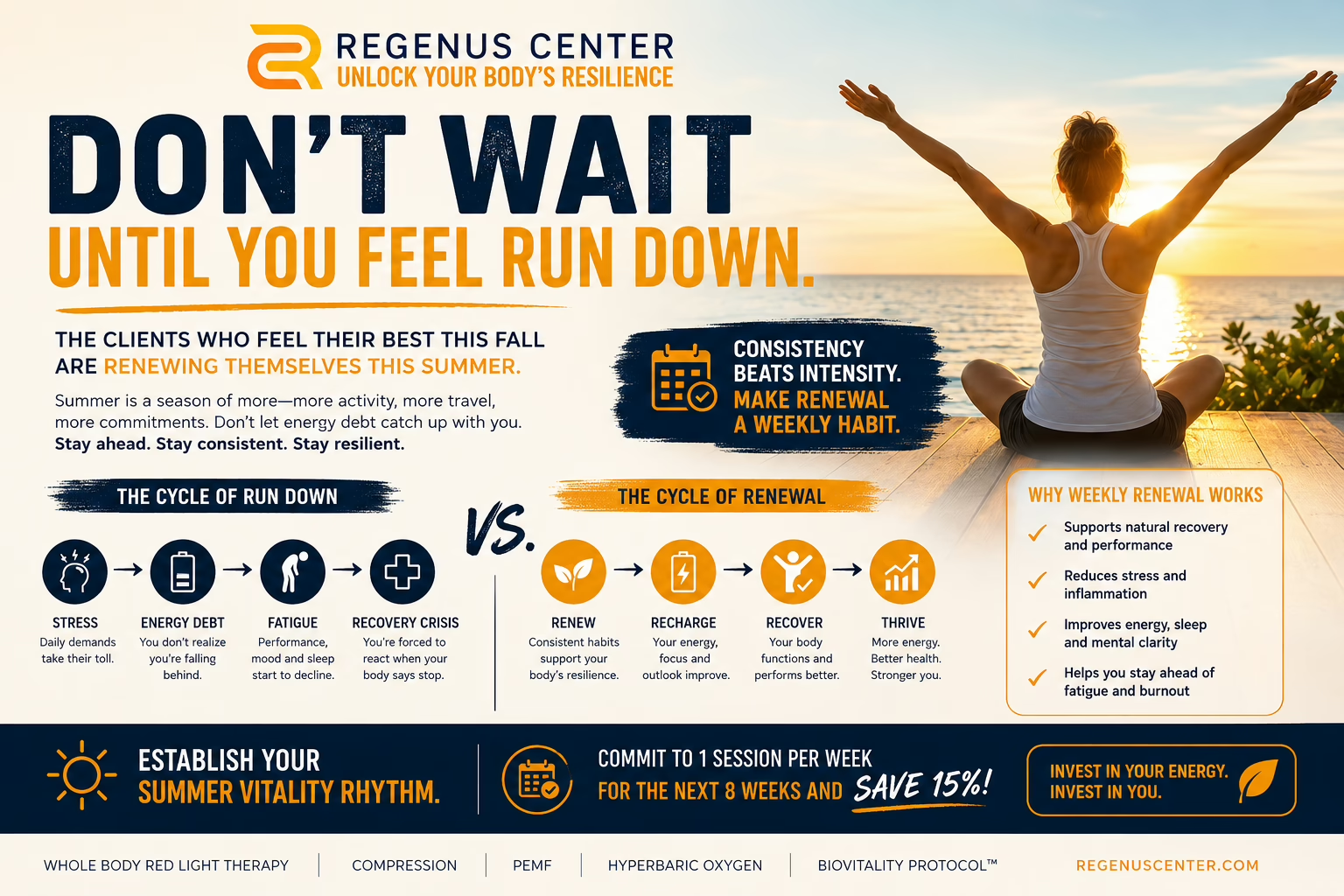
As we move through the summer months, don’t wait until your body forces you to pay attention.
Stay ahead.
Invest in renewal before you feel depleted.
Support your body’s natural ability to recover, adapt, and perform.
Because the clients who feel their best this fall won’t be the ones who pushed through the summer.
They’ll be the ones who renewed themselves throughout it.
That’s not just a better recovery strategy.
It’s a better way to live.
— JAM
Founder, Regenus Center
Energy Leads. The Body Follows.
Scientific Foundation Behind This Article
The article is supported by well-established research on:
- Allostatic Load (McEwen & Stellar) – cumulative physiological burden from chronic stress.
- Recovery Physiology – importance of recovery in adaptation and resilience.
- Mitochondrial Health & Energy Production – foundational to cellular function and vitality.
- Sleep and Performance Research (Walker, Dinges, et al.).
- Inflammation and Healthy Aging (“Inflammaging” literature).
- Exercise Recovery & Adaptation Science.
- Photobiomodulation Research supporting cellular energy metabolism and recovery.
The Science Behind Weekly Renewal
The concept of maintaining a regular rhythm of recovery and renewal is supported by decades of research in physiology, stress science, sleep medicine, and human performance.
1. Chronic Stress & Allostatic Load
Researchers Bruce McEwen and Eliot Stellar introduced the concept of allostatic load, describing the cumulative wear and tear on the body that occurs when recovery does not keep pace with life’s demands. Over time, elevated allostatic load is associated with fatigue, reduced resilience, impaired recovery, and accelerated aging.
Reference:
McEwen BS, Stellar E. Stress and the Individual: Mechanisms Leading to Disease. Archives of Internal Medicine. 1993;153(18):2093-2101.
2. Recovery Is Essential for Adaptation
Exercise physiology and performance research consistently demonstrate that adaptation occurs during recovery, not during the stress itself. Whether the stressor is physical, mental, or environmental, the body requires sufficient recovery to repair, rebuild, and improve function.
Reference:
Kellmann M. Enhancing Recovery: Preventing Underperformance in Athletes. Human Kinetics. 2002.
3. Sleep and Human Performance
Sleep is one of the most studied recovery processes in human biology. Research shows that inadequate sleep negatively affects energy, mood, cognition, reaction time, immune function, and recovery capacity.
References:
Walker MP. Why We Sleep. Scribner, 2017.
Watson NF et al. Recommended Amount of Sleep for a Healthy Adult. Sleep. 2015;38(6):843-844.
4. Mitochondrial Health and Energy Production
Mitochondria are responsible for producing the vast majority of cellular ATP (energy). Mitochondrial function is increasingly recognized as a foundational component of vitality, recovery, healthy aging, and performance.
Reference:
Nunnari J, Suomalainen A. Mitochondria: In Sickness and in Health. Cell. 2012;148(6):1145-1159.
5. Photobiomodulation and Cellular Energy
Photobiomodulation (red and near-infrared light therapy) has been shown in numerous studies to support mitochondrial function, cellular energy production, circulation, tissue recovery, and overall cellular resilience.
References:
Hamblin MR. Mechanisms and Applications of the Anti-Inflammatory Effects of Photobiomodulation. AIMS Biophysics. 2017;4(3):337-361.
de Freitas LF, Hamblin MR. Proposed Mechanisms of Photobiomodulation or Low-Level Light Therapy. IEEE Journal of Selected Topics in Quantum Electronics. 2016;22(3).
6. Physical Activity and Healthy Aging
Regular movement and exercise remain among the most powerful evidence-based interventions for maintaining function, reducing disease risk, supporting cognitive health, and improving longevity.
Reference:
Warburton DER, Bredin SSD. Health Benefits of Physical Activity: A Systematic Review of Current Systematic Reviews. Current Opinion in Cardiology. 2017;32(5):541-556.
Suggested Closing Statement
At Regenus Center, we believe that recovery isn’t a luxury—it’s a biological necessity. The goal isn’t simply to feel better when you’re run down. The goal is to stay ahead of fatigue, support your body’s natural resilience, and maintain the energy needed to live, work, and perform at your best.